
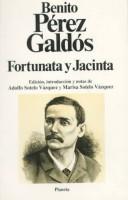
Fortunata and Jacinta
Benito Pérez Galdós · 1843–1920 · Spain
Originally Fortunata y Jacinta (Spanish)
Why it matters
A wife and a mistress, bound to the same faithless man, anchor a panoramic portrait of Madrid across every social class. Spain's answer to Balzac and Tolstoy, encyclopedic in ambition and remarkably even-handed in sympathy.
At a glance
Panoramic cast and Madrid-wide social detail across a very long novel.
Deep dive
Which of two women — the lawful wife or the disgraced mistress — the novel quietly argues is the truer spouse, and how Galdós's camera-eye realism refuses to let either side of Madrid's class divide win the argument outright.
Written for readers who have finished the book. No plot recap, and nothing here is safe to read first.
Themes & symbolism
Galdós stacks the deck in the title itself: Fortunata, the illegitimate lower-class woman Juanito seduced and discarded, gets top billing over Jacinta, his legal wife, and the six hundred pages that follow spend their sympathy accordingly. Jacinta is barren, patient, and impeccably genteel — everything Restoration Madrid asks of a bourgeois wife — while Fortunata is fertile, impulsive, and incapable of the social lie that her passion for Juanito is over. The novel's recurring vocabulary calls Fortunata's honesty "natural," a word Galdós uses almost as a moral category set against the manufactured respectability of the class that looks down on her: she cannot fake indifference to a man she loves, and the book treats that inability as integrity rather than weakness.
Maximiliano Rubín, the sickly, pious pharmacist's apprentice Fortunata marries in one of her attempts at respectability, is himself a study in wounded masculinity — impotent, humiliated, worshipful of a wife who was never emotionally his — and his family's fanaticism curdles into the violence that eventually kills her. Free indirect discourse lets Galdós slide inside a dozen minds without warning, a technique that anticipates Joyce and Woolf by decades and lets Madrid's shopkeepers, aristocrats, and street vendors argue past each other in the same paragraph, so that no single class's version of the story — least of all the respectable one — gets to stand as the novel's final word.
A Whole City as Character
Galdós's ambition is genuinely encyclopedic: shops, dowries, ecclesiastical gossip, and street layouts are rendered with a documentary density that made critics reach for Balzac and Tolstoy, and characters recur and cross-pollinate across his wider Episodios Nacionales project the way Balzac's do across the Comédie Humaine. The effect is a Madrid built to scale, in which Fortunata and Jacinta's private rivalry is only the load-bearing plot inside a much larger structure of class, commerce, and Restoration-era hypocrisy.
The last seal: what actually happens, and why it lands the way it does.
The ending, explained
Dying after a brutal final pregnancy and a beating inflicted by one of Maximiliano's fanatically pious relatives, Fortunata makes one last unsentimental transaction: she has her newborn son by Juanito delivered to Jacinta to raise as her own, rather than let him vanish into the Rubín family or be raised by a father who has already proven he'll abandon anyone. It reads as generosity, but it's also victory dressed as generosity — Fortunata dies believing she has finally given Jacinta the one thing Jacinta's whole marriage couldn't produce, closing the novel's long argument about which woman was the real wife in every sense except the legal one.
Where to go next
 Benito Pérez Galdós · 1876Doña PerfectaLvl 4Medium pace
 Honoré de Balzac · 1835Père GoriotLvl 4Medium pace
 Émile Zola · 1885GerminalLvl 5Medium pace
 Gustave Flaubert · 1857Madame BovaryLvl 5Slow burn
 Marcel Proust · 1913Swann's WayLvl 8Slow burn
 Camilo José Cela · 1942The Family of Pascual DuarteLvl 4Medium pace