
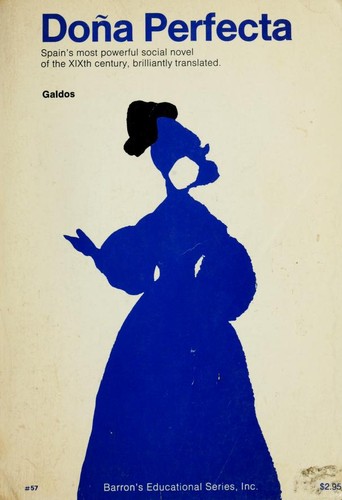
Doña Perfecta
Benito Pérez Galdós · 1843–1920 · Spain
Originally Doña Perfecta (Spanish)
Why it matters
A freethinking engineer arrives in a stagnant provincial town and collides with his zealot aunt over his cousin's hand. Galdós's sharpest early satire of clerical tyranny and Spanish provincial deadweight.
At a glance
Straightforward realist prose driven mostly by dialogue and social conflict.
Deep dive
Why a modern engineer's arrival in a provincial Spanish town he thinks he already understands turns into the bluntest allegory Galdós ever wrote about who actually controls the country.
Written for readers who have finished the book. No plot recap, and nothing here is safe to read first.
Themes & symbolism
Pepe Rey, a Madrid-trained engineer confident in reason, science, and liberal reform, arrives in the provincial town of Orbajosa expecting to marry his cousin Rosario and encounters instead his aunt Doña Perfecta, whose name Galdós deploys with open irony throughout, a woman whose absolute certainty in her own piety and rightness makes her incapable of recognizing her own cruelty as anything other than righteousness. Galdós builds Orbajosa itself, a town whose name literally means garlic-town, as a deliberate emblem of an entire Spain still organized around clerical authority, inherited land, and suspicion of anything arriving from Madrid, so that Pepe's engineering plans for the town read to its residents not as improvement but as an assault on everything that gives their world its shape.
Don Inocencio, the local canon who works alongside Doña Perfecta to destroy Pepe's standing in the town through rumor, forged evidence, and quiet manipulation of local opinion, gives the novel its clearest picture of caciquismo, the informal alliance of church and landed power that actually governed rural Spain far more than any law passed in the capital; Galdós is precise that neither Doña Perfecta nor Don Inocencio ever does anything so crude as lie outright, they simply arrange truth selectively and let provincial gossip do the rest, a method the novel treats as more dangerous than open villainy because it never has to answer for itself as villainy at all.
Rosario, caught entirely between her mother's absolute will and her own genuine love for Pepe, becomes the novel's real casualty long before the plot's violence arrives: Galdós tracks her slow psychological unraveling under sustained pressure from a mother she has never been permitted to openly defy, making her eventual breakdown the private, domestic version of the same authoritarian logic that destroys Pepe in public.
A Realist Novel Built Like a Fable
Galdós strips the novel's prose of the digressive social panorama that fills his later, longer Madrid novels, giving Dona Perfecta an almost fable-like compression instead, a modern man walking into an ancient town and being destroyed by it within a matter of months. That deliberate narrowness is part of the argument: Galdós wants Orbajosa to read as microcosm rather than isolated case, a single small town standing in for the reactionary, clerically governed Spain his entire generation of liberal reformers was trying, and largely failing, to modernize.
The last seal: what actually happens, and why it lands the way it does.
The ending, explained
Doña Perfecta, convinced entirely of her own righteousness, orders the town's irregular militia to shoot Pepe as he attempts one final nighttime meeting with Rosario in the garden, and he is killed on her explicit instruction, a devout woman having talked herself into murder without ever once believing herself capable of sin. Rosario, informed of what her mother has done, collapses entirely into a lasting madness and is committed to an asylum, the marriage plot's two young lovers both destroyed by the same absolute certainty that never once doubted itself. Doña Perfecta continues afterward exactly as before, pious, respected, and untouched by any public reckoning, Galdós closing the novel by refusing her the self-knowledge that might have made her tragic rather than simply, permanently dangerous.
Where to go next
 Benito Pérez Galdós · 1887Fortunata and JacintaLvl 6Medium pace
 Honoré de Balzac · 1835Père GoriotLvl 4Medium pace
 Émile Zola · 1885GerminalLvl 5Medium pace
 Gustave Flaubert · 1857Madame BovaryLvl 5Slow burn
 Marcel Proust · 1913Swann's WayLvl 8Slow burn
 Camilo José Cela · 1942The Family of Pascual DuarteLvl 4Medium pace