
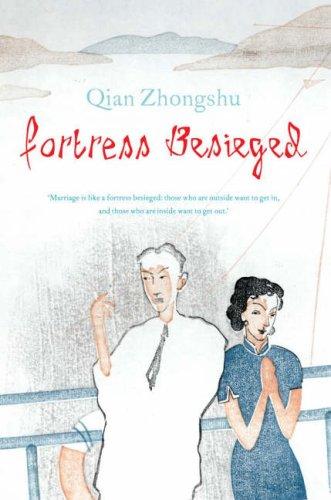
Fortress Besieged
Qian Zhongshu · 1910–1998 · China
Originally Weicheng (Chinese) · translated by Jeanne Kelly and Nathan K. Mao
Why it matters
A fraudulently credentialed young man drifts from failed romance into a miserable marriage. Chinese fiction's great satire of ambition and mediocrity, famous for the line that marriage is a fortress: those inside want out, those outside want in.
At a glance
Witty, allusion-dense prose packed with erudite wordplay and literary reference.
Deep dive
A fake diploma gets a mediocre man through nearly every door in this novel, and Qian Zhongshu is most interested in the one door it can't open.
Written for readers who have finished the book. No plot recap, and nothing here is safe to read first.
Themes & symbolism
Fang Hongjian returns from an unfocused, unfinished course of European study with a doctoral diploma he's purchased outright from a mail-order diploma mill, a decision the novel treats less as a moral failing than as the honest expression of a man who has always preferred the appearance of achievement to the discipline it requires. Qian's title comes from a proverb Fang hears secondhand, that marriage is a fortress besieged, those outside wanting in and those inside wanting out, and the novel spends its length proving the proverb applies to nearly every institution Fang enters, credentials, faculty appointments, romantic attachments, well before it finally applies to his marriage.
The middle of the book relocates Fang to a remote wartime university, San Lu, where the satire widens from one man's self-deception to an entire faculty's, professors maneuvering for rank and reputation with a pettiness the war raging outside campus never quite interrupts. Qian's ear for the specific vocabulary of academic vanity, the humble-brags, the imported theory dropped to intimidate colleagues, gives the campus chapters their own comic engine, and sets up the marriage plot that follows as simply the same self-serving performance relocated to a domestic register.
Sun Roujia, the colleague Fang eventually marries, is notable mainly for how little the novel, or Fang himself, ever seems to want her, compared to the women he actively pursued and lost earlier in the book. That's the sharper joke buried inside the fortress metaphor: the marriage that finally sticks isn't the one built on desire, it's the one that simply accumulated through drift, propriety, and the absence of any better alternative, exactly the mechanism the proverb describes rather than an exception to it.
The Diploma From Nowhere
Fang's purchased degree, from a fictional Carleton University that exists only as a mailing address, follows him through the rest of the novel as a low, persistent hazard rather than a onetime lie, resurfacing at dinners and interviews where he has to steer conversation away from his own supposed field of study. Qian treats the diploma as the templates for every other credential in the book, all of them appearances purchased or performed rather than earned, and Fang's discomfort at being asked to actually discuss his expertise is the novel's running joke about a whole class of returned students trading on prestige they never did the work to acquire.
A Comedy Written Inside a War It Barely Shows
Qian composed the novel during the Japanese occupation of Shanghai, yet the war appears almost entirely offstage, as the cause of displacement rather than as a subject in its own right, the flight inland to San Lu treated with the same comic register as everything else. That choice reads as deliberate rather than evasive: peacetime vanity persisting undiminished inside catastrophe is itself the argument. The novel was suppressed on the mainland for decades after 1949 as apolitical and bourgeois, and only found its wide readership internationally after a 1979 reissue and subsequent translation brought it back into print.
The last seal: what actually happens, and why it lands the way it does.
The ending, explained
Fang and Roujia's marriage decays through a string of increasingly bitter domestic arguments, culminating in a fight over her aunt's interference that sends her out of the apartment for good. Left alone, Fang notices an old clock inherited from his family, running several hours behind the correct time, its slow chime landing on the novel's final image. Qian doesn't resolve whether Fang will chase her, or find work, or ever finish anything he starts. The clock's wrong hour stands in for everything else in the book that has been running on borrowed, mismatched time, Fang's credentials, his career, and now his marriage, all of them structures he entered without ever quite catching up to what they actually required.
Where to go next
 Lu Xun · 1921The Real Story of Ah-Q and Other TalesLvl 5Fast paced
 Yan Lianke · 2005Serve the People!Lvl 4Fast paced
 Xiao Hong · 1935The Field of Life and DeathLvl 6Slow burn
 Ba Jin · 1933FamilyLvl 3Medium pace
 Paul Beatty · 2015The SelloutLvl 6Fast paced
 Pu Songling · 1766Strange Tales from a Chinese StudioLvl 5Fast paced