
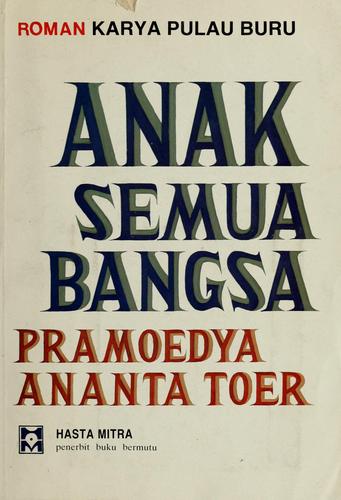
Child of All Nations
Pramoedya Ananta Toer · 1925–2006 · Indonesia
Originally Anak Semua Bangsa (Indonesian) · translated by Max Lane
Why it matters
Minke's political education deepens as he witnesses Dutch imperial power crushing Javanese peasants far beyond his own heartbreak. The Buru Quartet's second volume widens its indictment from personal awakening into systemic colonial critique.
At a glance
Continues the Quartet's plain realist style, though its widening cast and colonial bureaucracy demand attention.
Deep dive
How Minke's own household's legal defeat stops looking like the worst injustice in Java once he starts paying real attention to people with far less power than he has.
Written for readers who have finished the book. No plot recap, and nothing here is safe to read first.
Themes & symbolism
The volume opens in the wreckage of the first book: Annelies has died in the Netherlands within weeks of arriving, and Minke spends its early chapters barely functional, a printed obituary rather than the shrewd young journalist he was. Pramoedya uses that numbness deliberately. Minke's personal catastrophe was, by the scale of what colonialism does daily in Java, a comparatively well-documented and well-lawyered one, and the rest of the book is Minke's slow, humbled realization that his own suffering bought him no special insight into anyone else's.
Trunodongso, a peasant farmer Minke meets while investigating a Dutch sugar mill's expansion, gives the novel its rawest test of that realization. The mill wants Trunodongso's land, the colonial administration backs the mill without pretending at fairness, and there is no court, no petition, no fluent Dutch prose that will help him the way Minke's connections occasionally help Minke. Minke tries to write Trunodongso's case up as journalism and finds the exercise almost obscene: turning a man's ruin into copy for a Dutch-language paper he cannot even read.
A Painter's Daughter Between Two Names
Jean Marais, a French veteran who lost a leg fighting for the Dutch in Aceh and now paints for a living, and his daughter, who goes by both a French name and a Javanese one, Princess Kasih, give Minke a mirror he cannot look away from: a mixed household negotiating exactly his own instability of identity, but from one step removed, French rather than Dutch, so Minke can see the pattern clearly for once instead of living inside it. Marais's canvases, painted from a war he no longer defends, sit in the novel as a rehearsal for the clear-eyed reckoning Minke is only starting to manage in prose.
Writing Against the Colonizer's Language
Everything Minke has published so far, and every advantage that publishing has bought him, exists in Dutch, the language of the people doing the damage he is increasingly documenting. Nyai Ontosoroh and Ter Haar, a sympathetic Indo-European lawyer who has fought the family's case through every Dutch court and lost, both press Minke toward the same uncomfortable conclusion: that writing well for a Dutch audience is a dead end for the people he actually wants to reach, most of whom cannot read Dutch at all. The book closes with Minke committing to write in Malay instead, a decision the Quartet frames less as a literary choice than a political one, the first time Minke picks his own readers rather than the readers his education handed him.
Where to go next
 Pramoedya Ananta Toer · 1980This Earth of MankindLvl 4Medium pace
 Abdulrazak Gurnah · 1994ParadiseLvl 5Medium pace
 Multatuli · 1860Max HavelaarLvl 6Medium pace
 Mulk Raj Anand · 1935UntouchableLvl 3Fast paced
 Andrea Levy · 2004Small IslandLvl 4Medium pace
 Ngũgĩ wa Thiong'o · 1967A Grain of WheatLvl 6Slow burn