
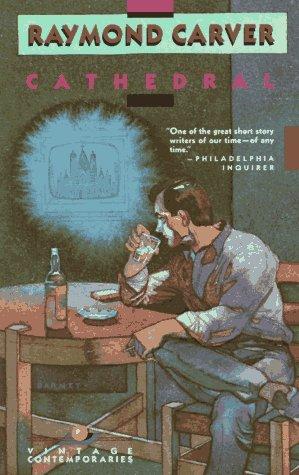
Cathedral
Raymond Carver · 1938–1988 · United States
Why it matters
A resentful husband's evening with his wife's blind friend ends in an unexpected, wordless moment of connection. The title story of Carver's finest collection, minimalism at its most quietly transcendent.
At a glance
Minimalist prose where meaning lives in what's left unsaid.
Deep dive
How Carver, two years after the harshest edit of his career, let his own sentences breathe again, nowhere more than in the title story's blind man and the meal that follows loss in "A Small, Good Thing."
Written for readers who have finished the book. No plot recap, and nothing here is safe to read first.
Themes & symbolism
The title story puts a resentful, unnamed narrator in his living room with Robert, his wife's blind friend, expecting an evening of awkward tolerance. Instead Carver builds, with none of the clipped withholding of the earlier collection, to an actual moment of transcendence: the narrator and Robert draw a cathedral together on a paper bag, the blind man's hand riding the narrator's, and the story ends on the narrator keeping his own eyes closed, genuinely moved, unwilling to break whatever has just happened between them by looking. It's the most openly hopeful ending Carver ever wrote.
"A Small, Good Thing" is the clearest evidence of that loosening: it restores, at full length, the story Gordon Lish had cut down to "The Bath" for the earlier collection, following a couple through their son's hit-and-run accident and hospitalization, and adding back an ending Lish had removed entirely, the grieving parents confronting the baker who has been harassing them with calls about an unpaid cake order, and sitting down to eat his bread with him at three in the morning. Where "The Bath" stopped at dread, this version earns real consolation.
Across the collection, Carver's people are still drinkers and strugglers, a recovering alcoholic in "Where I'm Calling From," a man watching his ex-wife's new husband move furniture into his old house in "Preservation," but the sentences give them room the earlier book never allowed, longer, more explanatory, willing to let a character's interior register on the page instead of vanishing into white space.
The Bath Becomes A Small, Good Thing
Placing the two versions side by side shows exactly what Lish's cuts had removed from Carver's fiction: not just length, but the possibility of comfort. "The Bath" ends on an unanswered, ringing phone, pure dread with nowhere to go. "A Small, Good Thing," published two years later once Carver had reclaimed editorial control, adds back forty pages in which grief actually gets somewhere, through anger at the baker, through his clumsy apology, through the bread itself. It's the single clearest before-and-after of what minimalism had cost Carver's fiction.
Drawing Blind: What the Cathedral Actually Draws Out
Robert's blindness in the title story isn't a disability the narrator has to accommodate so much as an alternative way of attending that the narrator, jealous, TV-numbed, contemptuous of his wife's old friendship, doesn't know he's missing. Asking the narrator to draw a cathedral he can't see the point of describing forces him into Robert's mode of perception rather than his own, and Carver stages the whole story as a rehearsal for actually noticing another person, something none of Carver's earlier, more clenched characters ever manage.
Where to go next
 Raymond Carver · 1981What We Talk About When We Talk About LoveLvl 4Medium pace
 Alice Munro · 2012Dear LifeLvl 5Medium pace
 Mavis Gallant · 2002Paris StoriesLvl 5Medium pace
 Sherwood Anderson · 1919Winesburg, OhioLvl 3Medium pace
 Anton Chekhov · 1899Selected StoriesLvl 4Medium pace
 John Cheever · 1978The Stories of John CheeverLvl 4Medium pace