
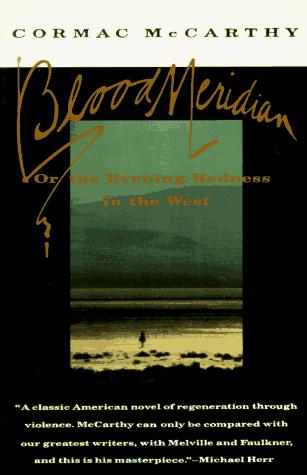
Blood Meridian
Cormac McCarthy · 1933–2023 · USA
Why it matters
A scalp-hunting expedition across the 1850s borderlands, presided over by the hairless, dancing, possibly immortal Judge Holden. The Western unmasked as national origin myth: biblical prose over a river of blood.
At a glance
Biblical, unpunctuated prose and relentless violence offer no moral scaffolding to lean on.
Deep dive
What it costs to read atrocity rendered in prose this beautiful, and whether the towering, ageless judge who presides over the killing is a man, a myth, or something worse.
Written for readers who have finished the book. No plot recap, and nothing here is safe to read first.
Themes & symbolism
McCarthy sets out to strip the American Western of every consolation the genre usually offers — no clear hero, no moral arc, no frontier civilized by decent men — and replaces it with the documented historical record of the Glanton gang's scalp-hunting rampage across the 1850s borderlands, contracted by Mexican authorities to kill Apaches for bounty and instead massacring almost anyone whose hair could be passed off as a kill. He renders all of it in prose modeled on the King James Bible and Homer, full of long processional sentences and biblical cadence, and that collision is the book's real argument: language this elevated is usually reserved for battles that redeem something, and McCarthy uses it instead to describe children shot for their scalps and whole villages burned for bounty fraud. The effect forces the reader to notice how easily atrocity gets dressed up as myth once it is given a sufficiently dignified vocabulary — exactly the process by which America's own founding violence was laundered into a heroic Western story in the first place, with the kid's numb passivity through most of it standing in for a nation's own selective memory.
Judge Holden, hairless, enormous, fluent in half a dozen languages, and seemingly incapable of aging, dominates the gang not through rank but through sheer persuasive will, delivering campfire sermons that build toward his central claim: war is the truest form of divination, the one activity that reveals what a man is actually worth, and "war is god" because it is the only trial whose outcome cannot be argued with. His compulsive habit of sketching, cataloguing, and then destroying the plants, fossils, and artifacts he records along the trail — insisting that nothing may exist in the universe without his knowledge and consent — turns him into something larger than a villain with ordinary motives: a personification of dominion itself, collecting the world only to prove he is also entitled to erase it. Every other character in the book, including the kid, is eventually measured against the Judge's total, cheerful amorality, and found to be still carrying some scrap of hesitation or conscience he has long since burned away.
Judge Holden: History Wearing a Myth's Face
The Judge is not wholly invented. Samuel Chamberlain's disreputable, likely embellished memoir My Confession, an eyewitness account of actually riding with the historical Glanton gang, describes a huge, hairless, strikingly erudite man named Judge Holden who played the fiddle, spoke several languages, and was already rumored among the men to be something other than ordinary — McCarthy lifts him almost whole out of that source and then amplifies him past any plausible historical scale. That sliver of documented basis is precisely what makes the character's uncanniness so unsettling: critics have argued for decades over whether he is meant literally as a demonic or supernatural figure incapable of dying, or simply as an ordinary, monstrously brilliant man whom the novel's biblical register inflates into something mythic. McCarthy's prose refuses to adjudicate between the two readings, offering visions, coincidences, and impossible knowledge on the Judge's part without ever confirming they are more than campfire legend.
A Prose Built to Resist Comfort
McCarthy strips out quotation marks entirely and lets dialogue run directly into description, so that speech carries no more special status than the landscape around it — a formal choice that flattens human utterance into just another feature of an indifferent terrain. Sentences pile up clause after clause in long unpunctuated strings, borrowing the King James Bible's parallelism and Melville's oceanic sweep, so that scenes of massacre arrive with the same grave, unhurried cadence as descriptions of desert light or a night sky. Nothing in the prose ever hurries toward judgment or comfort; the violence is never softened, but it is also never signaled as especially remarkable within the sentence that contains it, which is exactly how the novel wants its reader to notice their own numbing.
The last seal: what actually happens, and why it lands the way it does.
The ending, explained
Decades later, the gang long since destroyed — most of its members killed by Yuma warriors at a river crossing — the kid, now an aging, weathered man, crosses paths with the Judge again in a saloon in Fort Griffin, Texas, unaged, unchanged, still holding forth to a new audience. The novel's final violent act happens almost entirely off the page: the kid walks into an outhouse where the Judge is waiting, and McCarthy cuts away to other patrons recoiling in horror at what they glimpse inside, never once describing it directly. The brief, genuinely strange epilogue that follows shows a nameless man methodically striking postholes across the open plain while, elsewhere, the Judge dances and fiddles in a barroom, naked, announcing that he will never die — an image that refuses to settle whether he is literally immortal or simply means that the violence he embodies outlives every man who ever served it, organizing the land itself long after any single story about it has ended.
Where to go next
 Cormac McCarthy · 1992All the Pretty HorsesLvl 6Medium pace
 Cormac McCarthy · 2006The RoadLvl 4Fast paced
 William Faulkner · 1930As I Lay DyingLvl 9Medium pace
 Toni Morrison · 1987BelovedLvl 8Slow burn
 Joyce Carol Oates · 1969themLvl 6Medium pace
 Eudora Welty · 1972The Optimist's DaughterLvl 4Medium pace