
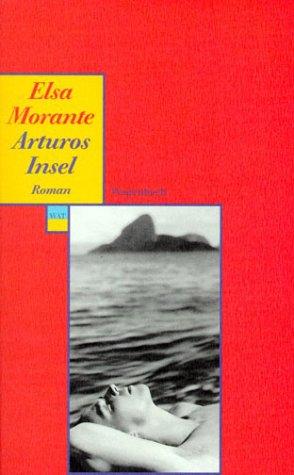
Arthur's Island
Elsa Morante · 1912–1985 · Italy
Originally L'isola di Arturo (Italian)
Why it matters
A boy's idyllic, motherless childhood on a remote Neapolitan island is shattered by his father's new wife and the truths she brings with her. Morante's lyrical coming-of-age novel won Italy's Strega Prize.
At a glance
Lyrical, sun-drenched prose belies a slowly darkening psychological plot.
Deep dive
Arturo builds his whole boyhood on Procida around a father he barely sees, and Morante spends the novel watching that private mythology buckle under a truth about where the man actually goes.
Written for readers who have finished the book. No plot recap, and nothing here is safe to read first.
Themes & symbolism
Arturo grows up motherless and largely unsupervised on Procida, an island in the Bay of Naples he treats as a private kingdom, developing what he calls his own absolute code, a boyish religion of virility and heroism modeled entirely on his father Wilhelm, who is glamorous, distant, and gone from the island for months at a time. Morante lets Arturo narrate his own childhood mythology with total sincerity, so the reader feels the force of his devotion before slowly recognizing, well ahead of Arturo himself, how much of it was built on a father's absence rather than his presence.
When Wilhelm returns with a teenage second wife, Nunziata, barely older than Arturo, the household's dynamics shift in ways Arturo can't yet name, and the truth he eventually pieces together, that his father's long disappearances are visits to a favorite young prisoner named Tonino Stella held at the island's real fortress prison, dismantles the god Arturo built his whole self-conception around. Morante writes the revelation with sorrow rather than judgment, and Nunziata, neglected by the husband who took her mostly to secure a housekeeper and heir, drifts toward Arturo in an ambiguous closeness that reads less like romance than like two people abandoned by the same man mistaking proximity for comfort.
Arturo's education is entirely self-directed, cobbled together from whatever books happen to be lying around the house, adventure stories and lives of conquerors and saints read indiscriminately and taken as equally literal, and Morante makes that homemade curriculum the direct source of the absolute code he lives by. A boy who has never once been corrected by a teacher builds his entire sense of honor out of borrowed grandeur, with no adult in his life positioned to tell him which parts of what he's read were ever meant as fiction.
Procida's Prison as the Island's Open Secret
The Casa Punitiva, an actual Bourbon-era prison that dominates Procida's geography, sits at the edge of Arturo's awareness for most of the novel exactly the way his father's secret does, visible, unremarked on, and eventually impossible to ignore. Morante, married to Alberto Moravia and writing from deep familiarity with the Bay of Naples, grounds the island's mythic weight in real topography, and the novel won Italy's Strega Prize in 1957, recognition that helped establish her as a major figure independent of her husband's already considerable reputation.
The Half-Brother Who Replaces Him
Nunziata's son by Wilhelm, born partway through the novel, quietly accomplishes what Arturo's own suspicions never fully manage: displacement. Once there is a legitimate infant heir asleep in the house, Arturo's years of being his father's entire reason for coming home are simply over, absorbed into ordinary domestic routine rather than ended by any confrontation, and Morante lets that unspectacular demotion do nearly as much damage to Arturo's self-mythology as the discovery of where his father actually goes.
The last seal: what actually happens, and why it lands the way it does.
The ending, explained
With his childhood mythology in ruins, his father unmasked, and a half brother now occupying the place he once held as Wilhelm's whole world, Arturo enlists as the Second World War approaches and leaves Procida for the mainland, ending the island seclusion that raised him. Morante offers no reconciliation scene with his father and no tidy verdict on Wilhelm's double life; Arturo simply ages out of the private kingdom he built to survive his own neglect, trading one absolute code, virility, heroism, a father's glamour, for the far less mythic uncertainty of an adult life beginning just as the wider world is about to make demands on it no island could have prepared him for.
Where to go next
 Elsa Morante · 1974History: A NovelLvl 5Medium pace
 Elena Ferrante · 2011My Brilliant FriendLvl 3Fast paced
 Grazia Deledda · 1913Reeds in the WindLvl 4Medium pace
 Giovanni Verga · 1881The House by the Medlar TreeLvl 6Slow burn
 Cesare Pavese · 1950The Moon and the BonfiresLvl 6Slow burn
 Natalia Ginzburg · 1963Family LexiconLvl 4Medium pace