
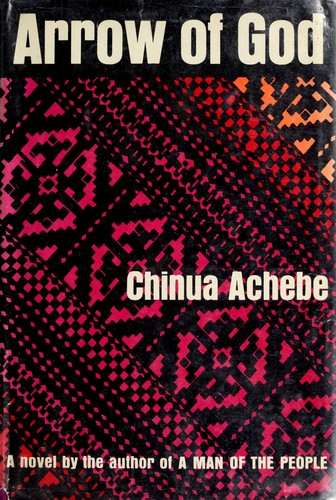
Arrow of God
Chinua Achebe · 1930–2013 · Nigeria
Why it matters
Ezeulu, priest of Ulu, caught between his god, his people, and the colonial administration: pride and misjudgment grinding a world down. Achebe's own favorite of his novels, and his most intricate.
At a glance
Denser plotting and more Igbo cosmology to track than its predecessor demands patience.
Deep dive
Why the priest who reads British colonial power more clearly than anyone else in Umuaro is the one who ends up starving his own people's harvest to prove a point.
Written for readers who have finished the book. No plot recap, and nothing here is safe to read first.
Themes & symbolism
Ulu, the deity Ezeulu serves as Chief Priest, was invented on purpose: the villages of Umuaro created him during a slave-raid crisis specifically so no single village's ancestral god could claim supremacy over the rest. Ezeulu's authority was built to be partial and answerable, never sovereign, and Achebe spends the novel testing what happens when a man holding a deliberately limited office starts acting as though it were absolute, at the exact moment a British administration is doing the same thing under a different name, calling military force tradition and indirect rule.
Captain Winterbottom's plan to make him a salaried Warrant Chief insults Ezeulu twice: it substitutes authority invented by a foreign power for the authority his village's ancestors granted him, and it assumes he wants the unchecked rule Umuaro never gave even its priests. His refusal costs him two months in custody, and that imprisonment, not any point of doctrine, is what leaves him a full moon behind on the ritual yams he must eat before declaring the Feast of the New Yam. What began as defiance of a colonial officer ends as a private grudge enacted on an entire harvest, and Achebe never lets the reader decide whether Ezeulu is defending Ulu's law or refusing to be seen giving in.
Watching the Enemy Up Close
Ezeulu tells his son Oduche plainly why he is sending him to the mission: not admiration, but the belief that a wise man keeps a foot in a potential enemy's house to see what is being planned there. He applies the same logic to his own visit to Winterbottom's court, going in person rather than sending a messenger, treating proximity to colonial power as reconnaissance rather than submission. Umuaro cannot tell a man observing his opponent from a man joining him, and when Oduche traps the neighboring village's sacred python in a box, the scandal shows how fast a strategy built on one man's private motives collapses once it is loose in a community that never agreed to run the experiment.
The last seal: what actually happens, and why it lands the way it does.
The ending, explained
Two moons behind on the ritual yams because of his imprisonment, Ezeulu refuses to move the Feast of the New Yam forward, insisting Umuaro wait until he has eaten the remaining yams on schedule. The crop rots in the fields while he holds his ground, and the Christian mission offers to accept the harvest's first fruits in Ulu's place instead, promising no punishment to anyone who brings a token yam to church. Before the standoff resolves, Ezeulu's eldest son Obika, already ill, is made to run the night-spirit's ritual course through the village and drops dead at the end of it. Umuaro reads Obika's death as proof his father's stubbornness has cost the clan too much, and mass defection to the church follows within days. Achebe's narrator closes on Ezeulu's broken reason, and a god who used one man's pride to write himself out of Umuaro's future.
Where to go next
 Chinua Achebe · 1958Things Fall ApartLvl 4Medium pace
 Chinua Achebe · 1960No Longer at EaseLvl 4Medium pace
 Chinua Achebe · 1966A Man of the PeopleLvl 4Fast paced
 Chinua Achebe · 1987Anthills of the SavannahLvl 7Medium pace
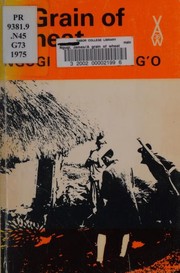 Ngũgĩ wa Thiong'o · 1967A Grain of WheatLvl 6Slow burn
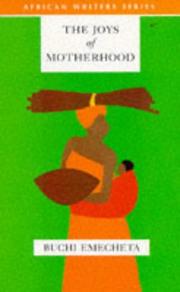 Buchi Emecheta · 1979The Joys of MotherhoodLvl 4Medium pace