
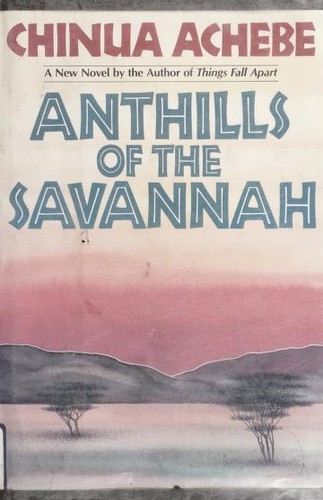
Anthills of the Savannah
Chinua Achebe · 1930–2013 · Nigeria
Why it matters
Three friends, one now a military dictator, one his minister, one a journalist, narrate in turns the slow unraveling of a fictional West African state from inside its corridors of power. Achebe's return to fiction after a twenty-year gap, and his most structurally daring novel.
At a glance
Multiple first-person narrators and a nonlinear structure demand tracking who's speaking and when.
Deep dive
Three old university friends now sit at very different points around the seat of power in Kangan, and Achebe spends the novel testing how much of a friendship survives once one of them becomes a dictator.
Written for readers who have finished the book. No plot recap, and nothing here is safe to read first.
Themes & symbolism
Sam, His Excellency, Chris Oriko, his Commissioner for Information, and Ikem Osodi, editor of the state newspaper, were classmates at Lord Lugard College before Sam seized power in a coup, and Achebe uses their long friendship to make the novel's central betrayal land as personal rather than abstract: Sam's slide into paranoid authoritarianism, demanding a referendum to make himself President for Life and isolating himself inside a cabinet of yes-men, is witnessed by two men who remember him as an equal and cannot make that memory match the man now signing arrest warrants.
Achebe splits the narration between Chris, Ikem, and eventually Beatrice Okoh, rotating whose consciousness gets to carry the story, and the shift is not just formal variety but an argument about who has standing to narrate a nation: Ikem, the writer, believes his columns can speak for Kangan's ordinary people until Sam has him killed for it; Chris, the insider, keeps believing proximity to power gives him leverage until it gets him killed too; Beatrice, sidelined for most of the book as Chris's girlfriend and a civil servant nobody in the regime takes seriously, is the one still standing when the men's competing theories of resistance have both failed.
The fictional Kangan and its capital, Bassa, are pointedly composite rather than a direct stand-in for any single country, though the coups, the state media control, and the casually murderous cabinet meetings would have read to Achebe's own Nigerian audience in 1987 as close to reportage; Achebe had lived through Nigeria's 1966 coups and the Biafran war his earlier fiction addressed more directly, and this novel's abstraction is its own kind of argument, that the machinery of a dictator devouring his own friends had become general enough by then to need no single flag.
A Name Reassigned Across a Cradle
In the novel's final scene, Beatrice organizes a naming ceremony for Elewa's newborn daughter, Ikem's child, a rite Igbo custom reserves for men to perform, and gives the baby the name Amaechina, may-the-path-never-close, a name customarily given to boys. Achebe stages the gender reversal as deliberate repair rather than incidental detail: the men who might have carried Kangan's future forward are all dead by this point, and the ceremony hands their unfinished work, explicitly, to a girl and to the women who raised her.
The last seal: what actually happens, and why it lands the way it does.
The ending, explained
Ikem is arrested and killed by the regime after his newspaper columns turn too openly critical of Sam's referendum, and Chris, fleeing the capital in the unrest that follows, is shot by a drunken soldier while trying to stop the rape of a young woman at a roadside checkpoint, a death with no political calculation behind it at all. Sam himself is toppled and killed offstage in the coup his own paranoia helped provoke, reported to the surviving characters only secondhand. Achebe declines to let any of the three men's deaths read as martyrdom with a clear payoff; the novel's actual ending is Beatrice's naming ceremony for Ikem's daughter, hope relocated deliberately away from the men who spent the book competing over how best to fix the country.
Where to go next
 Chinua Achebe · 1958Things Fall ApartLvl 4Medium pace
 Chinua Achebe · 1960No Longer at EaseLvl 4Medium pace
 Chinua Achebe · 1964Arrow of GodLvl 5Medium pace
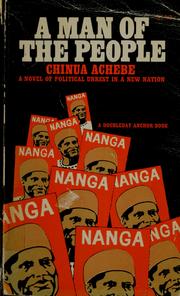 Chinua Achebe · 1966A Man of the PeopleLvl 4Fast paced
 Ngũgĩ wa Thiong'o · 1967A Grain of WheatLvl 6Slow burn
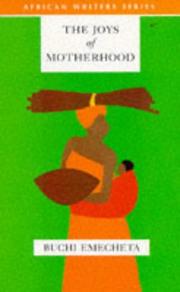 Buchi Emecheta · 1979The Joys of MotherhoodLvl 4Medium pace