
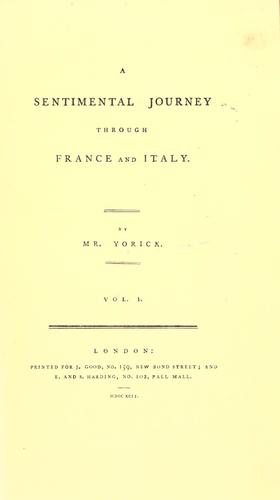
A Sentimental Journey Through France and Italy
Laurence Sterne · 1713–1768 · England
Why it matters
An amiable clergyman drifts through France chasing small encounters and stray sentiments rather than sights, turning travel writing inside out. Sterne's slighter, gentler companion piece to Tristram Shandy.
At a glance
Digressive 18th-century prose, though far shorter and looser than Tristram Shandy.
Deep dive
What a self-declared 'sentimental traveller' finds worth writing down when he ignores every cathedral and ruin most travel writers stopped for.
Written for readers who have finished the book. No plot recap, and nothing here is safe to read first.
Themes & symbolism
Sterne's Parson Yorick announces early that he is writing a different kind of travel book: not the antiquities, customs duties, or scenic set pieces that filled every prior account of the Grand Tour, but the small transactions of feeling between strangers, a monk asking for alms, a dead donkey's owner, a glove seller's shop. A Sentimental Journey treats sensibility itself, the capacity to be moved and to notice being moved, as the real subject worth touring for, and Yorick's attention keeps snagging on beggars, servants, and shopkeepers that a Grand Tourist of Sterne's day was trained to look straight through.
Yorick's sentiment is never quite disinterested, and Sterne lets the reader see the self-congratulation underneath the tenderness: he weeps over a caged starling that cannot get out, gives money to a monk he had just resolved to snub, and each act of feeling doubles as a small performance staged as much for Yorick's own satisfaction as for its object. Sterne is satirizing the cult of sensibility even while indulging it, which is why the book reads as sincere and knowing at once, never quite letting either reading win.
The travelogue's episodic looseness, Calais, then barely past it before the book runs out, mirrors Tristram Shandy's refusal to move in a straight line, except here the digressions are erotic rather than intellectual: near misses, hands that linger too long, doors left conveniently ajar. Sterne turns travel writing's promise of new territory into a running joke about how little actual geography a sufficiently distractible narrator needs to cover.
A Journey That Never Reaches Italy
The title promises France and Italy, but Sterne died in March 1768, weeks after publication, having written only the French leg. Two further volumes were rumored but never appeared. The book's incompleteness turns out to suit its method: a text this committed to interruption, to being derailed mid-anecdote by the next stranger who catches Yorick's attention, ends up literalizing its own digressiveness by simply running out of author before it runs out of road.
The last seal: what actually happens, and why it lands the way it does.
The ending, explained
The book stops mid-scene and mid-sentence, breaking off as Yorick, sharing an inn room overnight with a lady's maid on the far side of a makeshift dividing curtain, reaches out in the dark: "so that when I stretch'd out my hand, I caught hold of the Fille de Chambre's END." Sterne's own manuscript stopped there, and early editors added the bracketed word to mark the break rather than let readers assume a printing error. Whether by design or by the accident of an author running out of time to finish the book, the interruption became the fitting last joke of two volumes that had spent their whole length refusing to let any scene complete itself before the next distraction arrived.
Where to go next
 Laurence Sterne · 1759The Life and Opinions of Tristram Shandy, GentlemanLvl 9Slow burn
 Denis Diderot · 1796Jacques the FatalistLvl 6Slow burn
 Miguel de Cervantes · 1605Don QuixoteLvl 6Medium pace
 Jonathan Swift · 1726Gulliver's TravelsLvl 5Medium pace
 Henry Fielding · 1749Tom JonesLvl 5Fast paced
 John Barth · 1968Lost in the FunhouseLvl 7Slow burn