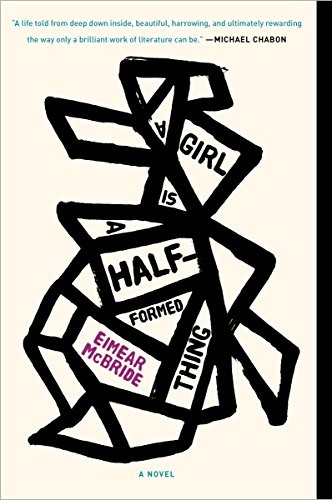
A Girl Is a Half-formed Thing
Eimear McBride · b. 1976 · Ireland
Why it matters
An unnamed Irish girl narrates her own abuse, grief, and self-destruction in fractured, pre-grammatical fragments, alongside her brain-tumor-surviving brother. A genuinely radical style, shattering syntax itself to render consciousness before it settles into sentences.
At a glance
Broken syntax with no quotation marks demands total, sentence-by-sentence reconstruction by the reader.
Deep dive
McBride tells a girl's whole life, her brother's illness, an uncle who shouldn't be trusted with either of them, years spent using her own body as a punishment, in a sentence structure that breaks apart exactly where the girl herself would rather not finish the thought.
Written for readers who have finished the book. No plot recap, and nothing here is safe to read first.
Themes & symbolism
McBride writes almost the entire novel in a broken, pre-grammatical syntax, sentences that start over, contradict themselves, or stop before finishing a thought, and the style isn't ornamental difficulty; it enacts a consciousness formed under conditions, a brother's childhood brain tumor, a mother's punishing Catholic guilt, that never let language settle into anything as stable as a complete sentence. The unnamed narrator addresses much of the book directly to her brother as 'you,' a structure that keeps his illness, first survived in childhood, then recurring in his twenties, as the narrative's real gravitational center even during the long stretches where the plot follows her instead of him.
Her uncle's sexual abuse, beginning when she is thirteen, is narrated with the same fractured, unpunctuated urgency as everything else in the book, refusing the reader the clarifying distance a more conventional trauma narrative would supply, and the self-destructive sexual encounters she pursues into adulthood, with strangers, with the same uncle again, read less as consequence in any tidy causal sense than as an attempt to locate some form of control inside a body she experienced as violated before she had language for what that meant. McBride grants the narrator no arc toward healing or insight; the repetition itself, encounter after encounter that resembles the original violation more than it resists it, is the book's most uncomfortable and most exact observation about how abuse actually persists in a life.
A Novel Written Toward the Ear
McBride has said she wrote much of the book to be read aloud, or at least sounded out silently at the pace speech moves rather than the pace prose is normally scanned, and the syntax rewards that approach: broken clauses that look chaotic on the page resolve into something closer to interrupted, overlapping thought when read for rhythm rather than grammar. The technique draws explicitly on Joyce, particularly the interior monologue of Ulysses and the more radical fragmentation of Finnegans Wake, but McBride's version is tuned to trauma rather than to consciousness in general, syntax that doesn't just represent a mind thinking but a mind flinching.
The last seal: what actually happens, and why it lands the way it does.
The ending, explained
The brother's cancer returns in his twenties and this time proves fatal, and his death removes the one relationship the entire fractured narrative has been oriented around, the 'you' the narrator has been addressing since childhood. Without him, the narrator's already destructive patterns accelerate past the point the novel has previously shown; in its final pages she walks into the river near her family's home, and McBride's prose disintegrates further as the scene proceeds, individual words rather than even broken clauses, until the narration itself effectively stops rather than concluding. The ambiguity is engineered rather than accidental: McBride declines to confirm the outcome as clearly as she confirmed the brother's, leaving the narrator's own ending as unresolved and as resistant to being fully articulated as the abuse that shaped her life was from the very first pages.