
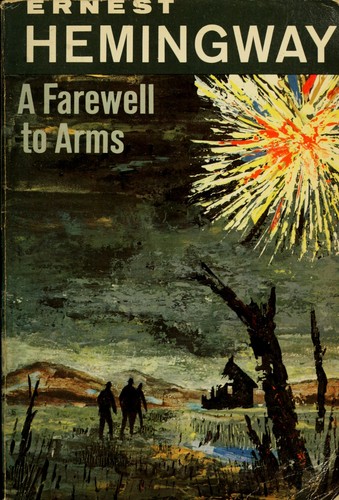
A Farewell to Arms
Ernest Hemingway · 1899–1961 · USA
Why it matters
Love and desertion on the Italian front, ending in the rain: Hemingway rewrote the last page thirty-nine times 'to get the words right.' The war novel and the love story fused, both stripped to the bone.
At a glance
Plain, declarative prose keeps surface difficulty low despite the war's brutality.
Deep dive
Hemingway strips a wartime love affair down to weather, wounds, and the flattest sentences he could write, and dares you to feel everything anyway.
Written for readers who have finished the book. No plot recap, and nothing here is safe to read first.
Themes & symbolism
Hemingway's famous flatness, short declarative sentences, dialogue stripped of adverbs, is not a lack of feeling but a theory about where feeling should live: beneath the surface, in what the iceberg leaves unsaid. Frederic Henry distrusts every abstract word the war supplies him, sacred, glorious, sacrifice, in a passage where he insists only concrete things, the names of villages, the numbers of roads, the dates, still carry any dignity. That distrust of rhetoric is the book's real style lesson: after enough dead men and burned villages, grand language becomes obscene, and only the plainest nouns can still be trusted.
Catherine Barkley tells Henry early on that she's afraid of rain because she sometimes sees herself dead in it, and Hemingway spends the rest of the novel making good on that fear, staging nearly every turn toward loss under a downpour: the retreat from the front, the crossing into Switzerland, the hospital at the end. Their affair in Switzerland reads as a deliberate separate peace, a private idyll built outside the war's reach in the mountains above Montreux, but the rain follows them there too, a reminder that love bought by desertion doesn't actually buy exemption from loss.
The Retreat from Caporetto
The novel's central set piece is drawn directly from the actual Battle of Caporetto, the October 1917 collapse of the Italian Army that Hemingway had witnessed firsthand as a Red Cross ambulance driver on the same front, before being wounded at Fossalta the following year. Henry's retreat alongside his fellow ambulance drivers, one shot for lagging, another lost to the mud, ends with Italian battle police summarily executing officers suspected of desertion at the Tagliamento river crossing. Henry escapes by diving into the river itself, and Hemingway frames the swim as a formal break with the army entirely, the moment Henry stops being a combatant and starts being only a man trying to reach the woman he loves.
Words Henry Won't Use
Henry's refusal of abstract wartime language, sacred, glorious, sacrifice, in favor of village names and road numbers isn't a throwaway aside, it's the closest the novel comes to a style manifesto. Hemingway had spent the 1920s in Paris absorbing Gertrude Stein's and Ezra Pound's insistence on precision, and this passage translates that aesthetic directly into Henry's own disillusionment: the grander a word gets, the more it's being used to dress up a corpse. Every flat sentence that follows is Henry, and Hemingway, making good on that distrust.
The last seal: what actually happens, and why it lands the way it does.
The ending, explained
After a long, difficult labor in a Lausanne hospital, Catherine's baby is stillborn, strangled by his own umbilical cord, and Catherine herself begins hemorrhaging and dies within the hour, despite Henry's attempts to comfort her with reassurances neither of them believes. Hemingway renders her death in the same flat, unadorned sentences that have carried the whole novel, refusing the reader any rhetorical cushioning even at the moment it would be easiest to reach for one. Henry's last act is trying to say goodbye to Catherine's body and finding it impossible, 'like saying goodbye to a statue,' before walking back to his hotel alone in the rain. The rain that Catherine feared from the beginning finally arrives on schedule, closing the separate peace they built together with the same indifference the war showed everyone else.
Where to go next
 Ernest Hemingway · 1926The Sun Also RisesLvl 4Fast paced
 Ernest Hemingway · 1952The Old Man and the SeaLvl 3Fast paced
 Robert Olen Butler · 1992A Good Scent from a Strange MountainLvl 4Medium pace
 Tim O'Brien · 1990The Things They CarriedLvl 4Medium pace
 Joan Didion · 1970Play It as It LaysLvl 6Fast paced
 Richard Ford · 1995Independence DayLvl 6Slow burn