
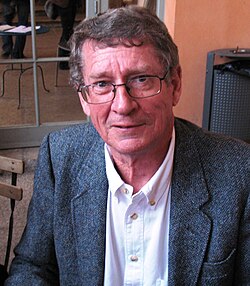
André Brink
South Africa
Tense and documentary, an investigative unraveling of complicity: controlled prose that closes off every route to easy innocence.
Brink studied in South Africa and Paris, and returned home from a formative stay in France in the early 1960s determined to write Afrikaans literature that confronted apartheid rather than served it, a stance that put him at odds with the Afrikaner literary and political establishment his language belonged to. His 1973 novel Looking on Darkness became the first Afrikaans book banned by the South African government, a status A Dry White Season and other later works repeated.
A Dry White Season, published in 1979, followed a politically naive white teacher radicalized after a Black colleague dies in police custody, translated by Brink himself into English to reach the wider audience Afrikaans censorship denied him at home. He taught literature for decades at South African universities, kept writing and translating across both languages through apartheid's end, and died in 2015 aboard a flight returning from an honorary degree ceremony in Belgium.
Their books in the atlas
- 1973
 Looking on DarknessLvl 6political novel
 - 1979
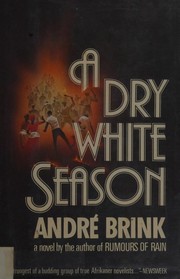 A Dry White SeasonLvl 5political novel
Meanwhile, elsewhere
 1932–2016Umberto EcoItalyWestern Europe · Italy
 1927–2015Günter GrassGermanyWestern Europe · Germany
 b. 1933Cees NooteboomNetherlandsWestern Europe · Netherlands
 1930–2024Edna O'BrienIrelandWestern Europe · Ireland1928–2016William TrevorIrelandWestern Europe · Ireland
 1933–2017David StoreyEnglandWestern Europe · England
If you like Brink, try
 1903–1988Alan PatonSouth Africashared movement: Postcolonial Literatures · kindred genres: political novel, tragedy · same region & era
 1926–2016Mahasweta DeviIndiashared movement: Postcolonial Literatures · kindred genres: political novel, tragedy
 b. 1938Ngũgĩ wa Thiong'oKenyashared movement: Postcolonial Literatures · kindred genres: political novel, crime & noir · same region & era
 1930–2013Chinua AchebeNigeriashared movement: Postcolonial Literatures · kindred genres: political novel, tragedy · same region & era
 1810–1865Elizabeth GaskellEnglandkindred genres: political novel, tragedy · neighboring movements
 1930–2012Barry UnsworthEnglandkindred genres: tragedy · neighboring movements