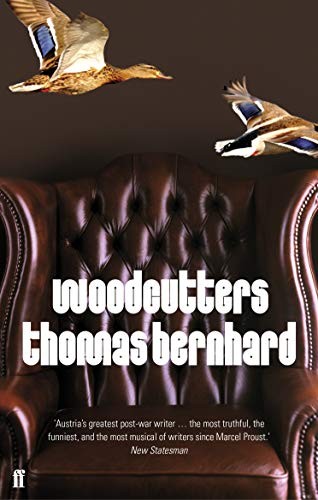
Woodcutters
Thomas Bernhard · 1931–1989 · Austria
Originally Holzfällen (German)
Why it matters
A guest at a Viennese dinner party sits in an armchair silently eviscerating the pretensions of everyone present in one furious, unbroken interior rant. Bernhard's essential mode: relentless, incantatory contempt for Austrian cultural hypocrisy.
At a glance
One extended, breathless, paragraph-free rant with almost no scene breaks.
Deep dive
Why one man sits silently raging in a wing chair through an entire Viennese dinner party the same day he buried a friend, and what that fury is actually covering for.
Written for readers who have finished the book. No plot recap, and nothing here is safe to read first.
Themes & symbolism
Bernhard's narrator spends the entire novel seated in a wing chair at an "artistic dinner" hosted by the Auersbergers, watching without ever quite managing to leave, his fury unspooling in obsessive, recurring refrains, "sitting in the wing chair, I thought," that structurally mimic the trapped, recursive quality of resentment itself. Bernhard turns one evening of small talk and canapés into a full indictment of an entire cultural class, Vienna's self-congratulating artistic bourgeoisie, without the narrator ever raising his voice out loud.
Joana, the actress and dancer buried that same afternoon after hanging herself in a country cottage, is the evening's unspoken center, mentioned, gossiped about, and then set aside as the party proceeds to self-congratulation and professional networking. The narrator's rage is directed as much at the Auersbergers and their circle as at himself, for having let the same drift from friendship into indifference happen to his own relationship with Joana long before her death made it irreversible.
Bernhard withholds paragraph breaks almost entirely, so the narrator's silent tirade reads as one continuous held breath stretched across the length of a dinner, a formal choice that makes politeness itself feel like the real violence being performed at the table. Every course, every toast, every reminiscence about the old artistic circle around the composer figure the narrator once idolized becomes one more log on a fire that never gets to burn out loud, the guests going on eating and talking entirely unaware of the verdict being passed on them in the wing chair a few feet away.
The Lawsuit That Pulled Woodcutters From Shelves
The composer Gerhard Lampersberg recognized himself in the character of Auersberger on the novel's 1984 publication and sued for defamation, winning a court injunction that had copies seized from Austrian bookshops until Bernhard and his publisher revised identifying details. The scandal became inseparable from the book's reception in Austria, which is exactly the kind of controversy Bernhard had spent his career provoking on purpose, an author whose contempt for his own country's cultural institutions kept finding those institutions willing to prove him right.
The last seal: what actually happens, and why it lands the way it does.
The ending, explained
The long-delayed guest of honor, a Burgtheater actor arriving straight from a performance of Ibsen's The Wild Duck, finally holds court with a self-satisfied monologue about his own genius, precisely the kind of vain performance the narrator has spent the whole evening silently despising in everyone else present. Rather than confront anyone aloud, the narrator leaves still seething, walking Vienna's streets at dawn composing, in his head, the tirade he has just delivered to the reader for hundreds of pages, and resolving never to see any of these people again, a resolution the book gives no reason to trust given how often Bernhard's narrators claim exactly this. Nothing has actually changed by the last page, which is Bernhard's real point: contempt this total isn't a path out of Vienna, it's Vienna's native language, spoken fluently even by the man silently damning everyone who speaks it.