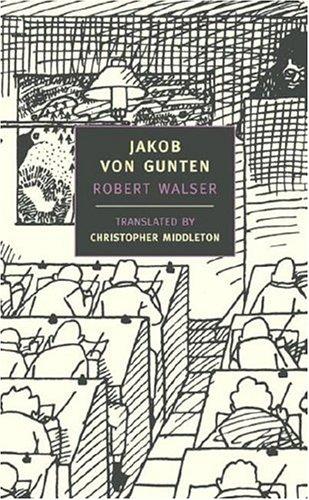
Jakob von Gunten
Robert Walser · 1878–1956 · Switzerland
Originally Jakob von Gunten (German) · translated by Christopher Middleton
Why it matters
A young man enrolls at a strange school that trains its students to become perfectly, willingly 'nothing.' A small, hypnotic novel of self-erasure that Kafka, Musil, and Benjamin all singled out for its uncanny originality.
At a glance
Strange, hypnotic diary voice whose flatness conceals real unease.
Deep dive
A young man enrolls at a school with only one real subject, how to want nothing, and Walser's diary of the attempt turns humility into the strangest ambition in the book.
Written for readers who have finished the book. No plot recap, and nothing here is safe to read first.
Themes & symbolism
The Institute Benjamenta trains its handful of students, boys and young men from good families gone to seed, in almost nothing but deportment: bowing, waiting, obeying, becoming servants so thoroughly self-effacing they cease to register as individuals at all. Jakob, who enrolls voluntarily and keeps a diary of the experience, treats the school's absurdly thin curriculum with an irony that never quite curdles into rebellion, since some part of him genuinely wants what the Institute is selling, a self small enough to stop being a burden to itself.
Kraus, Jakob's fellow student, takes the Institute's teachings with total sincerity where Jakob keeps a saving distance, and the contrast is the novel's real engine: Kraus's plodding, uncomplaining devotion to smallness reads at times like the only honest response to the school's philosophy, making Jakob's cleverer, more self-aware version of the same submission look like a kind of cowardice, wanting credit for humility rather than actually practicing it.
Herr Benjamenta, the headmaster, and his sister Fräulein Lisa Benjamenta run the school alone, with no other staff and, it gradually emerges, almost no other students behind its imposing name, so that the institution Jakob describes with such ceremony is really just two exhausted, grieving siblings and a handful of boys in an underfurnished house. Walser lets that discovery arrive slowly, so the reader's growing suspicion that the Institute is a kind of theater staged for its own students tracks Jakob's own dawning, half-welcomed disillusionment. Even the building itself, drawn in careful, almost loving detail across the diary's short entries, a dim corridor here, a shabby classroom there, comes to feel less like an institution than like a stage set slowly running out of money to maintain its own illusion.
A Diary That Refuses to Grow Up
Walser gives Jakob a voice that stays reportorial and childlike even as the events around him turn genuinely strange, Fräulein Benjamenta's decline, her brother's private despair, rendered in the same flat, faintly comic register Jakob uses for classroom gossip. Kafka, Musil, and Walter Benjamin each singled out that flatness as the book's real innovation: a narrator whose refusal to dramatize his own experience becomes, cumulatively, more unsettling than any amount of overt anguish would have been.
The last seal: what actually happens, and why it lands the way it does.
The ending, explained
Fräulein Benjamenta dies partway through the book's final stretch, worn down by a grief the novel never fully explains, and her death empties the Institute of whatever purpose it still had; the other students drift off one by one until only Jakob and Herr Benjamenta remain in the building. Rather than end on that emptiness, Walser has the headmaster propose one last, radical act of self-erasure: abandoning the Institute altogether and setting off with Jakob for the desert, a plan neither man bothers to justify or plan out. Jakob agrees without much deliberation, and the novel ends on the two of them departing into an unspecified nowhere, the school's whole philosophy of wanting nothing taken, finally, to its logical and genuinely uncertain conclusion.