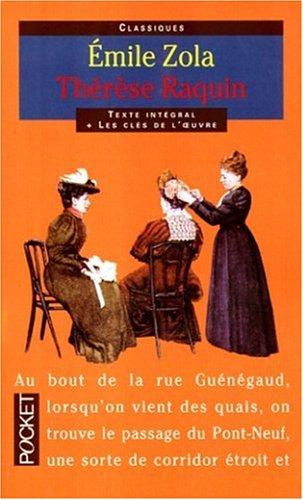
Thérèse Raquin
Émile Zola · 1840–1902 · France
Originally Thérèse Raquin (French)
Why it matters
Adultery, murder, and two 'human animals' destroyed by their own nerves: Zola's first sensation, defended with the manifesto that launched naturalism. Short, lurid, and clinically merciless.
At a glance
Short, tight, and clinical; a fast, unambiguous naturalist plot.
Deep dive
A woman trapped in a suffocating marriage takes a lover, and the two of them solve their problem in a way the rest of the novel spends making them regret in the most physical terms Zola can manage.
Written for readers who have finished the book. No plot recap, and nothing here is safe to read first.
Themes & symbolism
Zola's preface frames the novel as a scientific study of temperaments rather than characters, and Therese Raquin plays that claim out with real rigor: Therese and Laurent are driven to their affair, and then to drowning Therese's sickly husband Camille in a staged boating accident, by something closer to physiology than to romantic passion, appetite and restlessness that the marriage plot has simply been suppressing rather than resolving. The murder doesn't free them into the passion it was meant to enable; it converts their bodies into instruments of punishment instead, each touch between them producing a physical revulsion, nightmares, involuntary flinching at the sight of Camille's drowned, greenish face surfacing in their own memories, that no amount of willed forgetting can override.
Zola stages guilt as strictly bodily rather than spiritual throughout, refusing any of the religious machinery, confession, redemption, divine judgment, that a more conventional novel would supply; what punishes Therese and Laurent instead is their own nervous systems, breaking down under a strain their conscious minds keep trying to rationalize away. Camille's cat, staring at Laurent with what he reads as accusation, and the small back-room shop where the whole plot unfolds, cramped, airless, permanently lit by gaslight, do the atmospheric work a more sentimental novel would assign to guilt-stricken introspection, keeping the horror external and physical exactly as the preface promises.
Madame Raquin's Silent Verdict
Camille's mother, paralyzed by a stroke brought on by grief and unable to speak, becomes the novel's most devastating instrument of judgment precisely because she can do nothing else: she overhears Therese and Laurent's increasingly unguarded quarrels, understands exactly what happened to her son, and is reduced to communicating her fury only through her eyes, which the couple can feel on them constantly and can do nothing to escape. Zola gives the era's usual moral reckoning, a wronged party's righteous confrontation, to a woman who is physically incapable of delivering it, which makes her silent, watching presence at the family's weekly card games one of the bleakest images in the book: justice arriving as pure, helpless witness.
The Corpse That Won't Stay Drowned
Camille's face keeps resurfacing in the novel's imagery long after his actual body is buried, in the greenish tint Therese and Laurent both start seeing in mirrors and in each other's skin, in a formal visit to the Paris morgue Laurent makes that puts an unrelated corpse's face directly in front of him as though daring him to recognize it. Zola uses the recurring drowned face less as a ghost story device than as a literalized nervous symptom, guilt manufacturing hallucination the way an infection manufactures fever, entirely consistent with the novel's insistence that what happens to Therese and Laurent is physiological breakdown rather than supernatural haunting.
The last seal: what actually happens, and why it lands the way it does.
The ending, explained
Unable to bear either their guilt or each other any longer, and with Madame Raquin's accusing silence a permanent fixture at their table, Therese and Laurent each secretly resolve to poison the other, only to discover, in the scene that closes the novel, that both have prepared the same fatal drink at once. Rather than carry out separate plans, they drink the poison together in front of Madame Raquin, a final, mutual acknowledgment that neither the marriage of convenience nor the murder that was supposed to free them from it ever gave them anything worth surviving for. Madame Raquin, paralyzed and silent throughout, is left alone with both bodies at her feet, and Zola's last image is her satisfied, unmoving stare, the one character granted anything like vindication, delivered without her ever managing to speak a single word of it aloud.