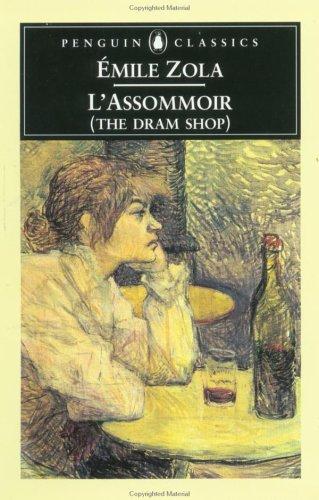
L'Assommoir
Émile Zola · 1840–1902 · France
Originally L'Assommoir (French)
Why it matters
A hardworking laundress's slow ruin by drink and poverty in a Paris slum: naturalism's most devastating case study, so unflinching about alcoholism and squalor that it scandalized readers who thought Zola had gone too far even for him.
At a glance
Phonetic, slang-inflected dialogue and unrelenting naturalist detail make for an immersive, demanding read.
Deep dive
A hardworking Paris laundress builds a small, precarious respectability out of nothing, and Zola spends the rest of the novel demonstrating, with almost scientific patience, exactly how little it takes to unbuild it.
Written for readers who have finished the book. No plot recap, and nothing here is safe to read first.
Themes & symbolism
Gervaise Macquart opens the novel abandoned by her first lover, raising two young sons alone in a Paris slum, and for a while her story reads like an argument against the very naturalist pessimism Zola is famous for: she works relentlessly as a laundress, marries the steady roofer Coupeau, and eventually opens her own shop, achieving a fragile, real prosperity through nothing but labor and discipline. Zola lets that upward arc run long enough to feel earned before he starts dismantling it, and the dismantling has a specific engine, Coupeau's fall from a roof, an injury that idles him into depression and then into the alcoholism that will eventually consume them both, since idleness in this world isn't a moral failing so much as the first domino in a mechanism Zola treats with the detachment of a clinical case study.
The novel's title names its central image directly: l'assommoir is Père Colombe's dram-shop, and at its center sits an actual copper still, described in near-mechanical, almost monstrous detail, distilling the poison that will eventually claim Coupeau's sanity and then Gervaise's own body. Zola's naturalist thesis, that heredity and environment determine fate as reliably as physics, runs through Gervaise's own family history of drink and through the slum's every structural incentive toward ruin, so that her final collapse reads not as a moral lesson about weak character but as the predictable output of an environment engineered, by poverty and habit, to produce exactly this outcome in exactly this population.
A Novel Written in the Street's Own Language
Zola built the book's dialogue out of Parisian working-class slang and argot, a choice contemporary critics treated as a scandal in itself, coarse language given the same narrative dignity usually reserved for a bourgeois protagonist's polished French. That linguistic realism did as much to provoke outrage on the novel's 1877 publication as its subject matter did, since it refused readers the comfortable distance a more formal narrating voice would have supplied, immersing them instead in the actual sound of the world Gervaise is trying, and failing, to escape.
The last seal: what actually happens, and why it lands the way it does.
The ending, explained
By the novel's final stretch, Coupeau's alcoholism has curdled into delirium tremens and repeated confinements in an asylum, Lantier, Gervaise's former lover, has moved back in as an openly tolerated second husband under the same roof, and the laundry shop that once represented Gervaise's whole claim to a better life has failed completely. Gervaise herself, having absorbed the same habits that destroyed Coupeau, descends through hunger and casual prostitution into a filthy cubbyhole under a staircase, where she dies alone and unremarked, her death barely registered by neighbors who have seen this exact ending too many times to treat it as tragedy anymore. Zola refuses her any last redemptive scene; the novel simply lets its mechanism run to its logical, unglamorous conclusion.