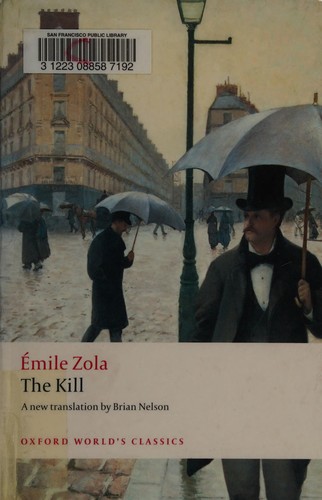
The Kill
Émile Zola · 1840–1902 · France
Originally La Curée (French)
Why it matters
A property speculator's wife drifts into an affair with her own stepson while Haussmann's Paris is demolished and rebuilt for profit around them: Zola's early Rougon-Macquart portrait of Second Empire greed, incest, and real estate as appetite.
At a glance
Lush, decadent prose and a large Second Empire social cast.
Deep dive
Why Hugo's Paris gets rebuilt as a cathedral and Zola's gets carved up like game after a hunt, and what that title is actually naming.
Written for readers who have finished the book. No plot recap, and nothing here is safe to read first.
Themes & symbolism
La curée names the portion of a kill thrown to the hounds once a hunt is finished, and Zola builds the whole novel around that image applied to Baron Haussmann's demolition and reconstruction of Paris under the Second Empire: Aristide Saccard, having changed his name to distance his real estate speculation from his more respectable brother's politics, makes his fortune buying up property along the routes of streets not yet publicly announced for demolition, profiting directly from inside knowledge of which neighborhoods the city is about to tear apart. Paris itself is the prey being divided among the hounds fast enough to get there first, and Zola's own prose keeps the hunting language explicit rather than incidental, treating urban speculation as a blood sport dressed in surveyor's plans.
Renée, Saccard's young second wife, has been furnished with every fashionable luxury money can buy and nothing whatsoever to actually want, and her drift into a near-incestuous affair with her husband's own son from his first marriage, the effete, indolent Maxime, reads less as scandal for its own sake than as the logical output of a life engineered entirely around consumption with no remaining object worth consuming; Zola stages their affair inside a hothouse crowded with exotic, unnaturally forced plants, a setting that makes the transgression feel cultivated rather than spontaneous, desire grown under glass the same way Saccard's fortune is grown on paper.
Saccard's discovery of the affair produces no real crisis of feeling in him at all, only a calculated fury at being cuckolded by his own son that he immediately puts to financial use, extracting a final humiliating settlement from Renée before abandoning her entirely once her own money runs out; Zola's flattest, cruelest joke is that even personal betrayal gets processed through Saccard's accounting rather than his heart, since nothing in his life, including his marriage, was ever anything but capital.
Haussmannization as the Novel's Real Plot
Zola researched the actual mechanics of Second Empire property speculation closely enough that Saccard's schemes, buying condemned buildings for a fraction of the compensation the city will eventually pay, then splitting the payout with corrupt officials who approve the routes, reflect documented practices rather than invented melodrama. The rebuilding of Paris that later generations would romanticize as grand civic improvement is presented here from the inside as a feeding frenzy, with the boulevards themselves standing as the visible scar tissue of exactly the kind of profiteering the title's hunting metaphor names outright.
The last seal: what actually happens, and why it lands the way it does.
The ending, explained
Once Saccard has extracted what remains of Renée's fortune to settle her debts and cover his own exposure, he sends Maxime off to marry a wealthy heiress without hesitation and discards Renée entirely, leaving her broke, socially ruined, and estranged from a father who is himself horrified by what she has become. She dies not long after from what the novel describes as an inflammation of the brain, alone and largely unmourned, while Saccard, entirely unpunished, is already deep into his next speculative scheme by the final pages, having converted his own wife's ruin into simply one more line item absorbed and forgotten inside a fortune that keeps growing regardless of who gets thrown to the hounds along the way.