
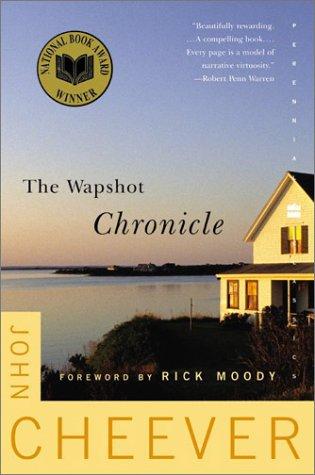
The Wapshot Chronicle
John Cheever · 1912–1982 · United States
Why it matters
Two brothers leave their decaying New England seaport and its proudly eccentric family behind to make their way in the world, in Cheever's first novel. A comic, elegiac chronicle of a vanishing WASP world that won the National Book Award.
At a glance
Episodic, digressive structure loosely strings together a family's fortunes.
Deep dive
How Cheever turns the settling of a rich, controlling relative's inheritance conditions into an occasion for chronicling the last generation of an old New England seafaring family — and what the family's decrepit ferry boat is doing carrying so much of the book's feeling.
Written for readers who have finished the book. No plot recap, and nothing here is safe to read first.
Themes & symbolism
Leander Wapshot runs the Topaze, a ferry boat that has gone from proud enterprise to barely-seaworthy joke, and the boat's slow indignity is the novel's central image for St. Botolphs itself: a once-vigorous agrarian and seafaring world reduced to picturesque decline, sustained more by eccentricity and memory than by any actual function. Leander's sons, Moses and Coverly, are sent out into the world under the terms of their formidable cousin Honora's will — inherit only if you marry and produce an heir — a condition that turns the anxious, comic business of proving one's manhood and continuing the family line into the engine of the plot, even as the novel keeps gently suggesting that no amount of virility will actually save what's already passing away.
Cheever's real subject is generational passage rather than crisis: Moses becomes a conventional striving company man, Coverly a quieter, more uncertain drifter into military service and office work, and neither brother's story resolves into triumph or ruin so much as ordinary, imperfect adulthood — the same unglamorous continuation Leander's own life represents. Underneath the comedy sits real elegy for a WASP world of proud eccentrics, seasonal rhythms, and inherited manners that the novel loves precisely because it knows the world is already gone, or going, even as it's being lovingly chronicled.
Cheever's Own Wapshots
Cheever drew the Wapshots' faded gentility and eccentric grandeur directly from his own upbringing in Quincy, Massachusetts, where his father's business failure had reduced a once-comfortable family to genteel, embarrassed decline — the same gap between inherited self-regard and diminished present circumstance that defines St. Botolphs. The comic set pieces (Leander's journal of gnomic advice to his sons, the costume mishap that finds Moses caught in women's clothes at cousin Justina's mansion) sit over a current of real unhappiness that runs through nearly everything Cheever wrote: his own alcoholism and the suppressed bisexuality he spent decades concealing behind a convincingly patrician exterior, the same tension between decorous surface and buried disorder he gives every Wapshot in turn.
That double register — genuinely funny, genuinely sad, often in the same sentence — is what makes this specifically a Cheever novel rather than just a nostalgic family saga, and it's the same instinct that later produces stories like 'The Swimmer' and the suburban despair of Bullet Park: comedy as the socially acceptable container for grief a New England family has no other permitted way to express.
The last seal: what actually happens, and why it lands the way it does.
The ending, explained
Neither brother's story resolves into anything like triumph. Moses marries the eccentric Melissa Scaddon and settles into a conventional, faintly hollow business life; Coverly marries Betsey and drifts into a quieter, more uncertain existence, the technical, modern world of his electronics job about as far from Leander's ferry boat as the novel can place him. Honora's inheritance conditions are technically satisfied, but the satisfaction is muted rather than climactic — the novel isn't interested in rewarding anyone so much as recording what actually happens to people once a fortune's conditions are met.
The real ending is Leander's death by drowning while swimming, rendered with the same mixture of comic incidental detail and genuine tenderness that defines the whole book — an old man of the water dying in it, unglamorously, the Topaze's slow decline finally completed in its owner. Cheever closes not on resolution but on passage: the old agrarian, seafaring New England world Leander embodied gives way, imperfectly and without ceremony, to whatever more uncertain modern life his sons are making instead, and the novel's final tone is less mourning than clear-eyed, affectionate acceptance that this is simply how generations replace each other.
Where to go next
 John Cheever · 1978The Stories of John CheeverLvl 4Medium pace
 Anton Chekhov · 1899Selected StoriesLvl 4Medium pace
 Peter Taylor · 1986A Summons to MemphisLvl 5Slow burn
 Mavis Gallant · 2002Paris StoriesLvl 5Medium pace
 Richard Yates · 1961Revolutionary RoadLvl 4Medium pace
 Alice Munro · 2012Dear LifeLvl 5Medium pace