
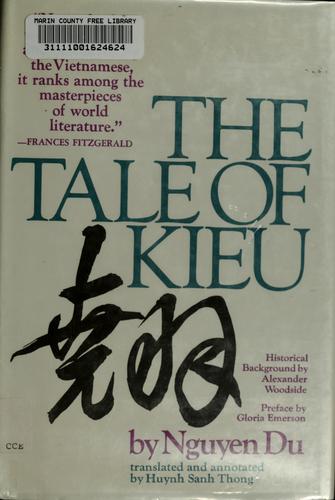
The Tale of Kiều
Nguyễn Du · 1765–1820 · Vietnam
Originally Truyện Kiều (Vietnamese) · translated by Huỳnh Sanh Thông
Why it matters
A gifted, dutiful daughter sells herself into years of degradation to save her father, enduring brothels, forced marriage, and exile across a decade of relentless misfortune. Vietnam's national epic in verse: still recited from memory, quoted in speech, and consulted like an oracle.
At a glance
Dense classical allusion and strict six-eight verse form challenge readers unfamiliar with Nôm poetic convention.
Deep dive
Why a two-century-old verse epic still gets opened at random for fortune-telling in Vietnam, and what its famous closing claim, that heart outweighs talent, has to survive to be believed.
Written for readers who have finished the book. No plot recap, and nothing here is safe to read first.
Themes & symbolism
Nguyễn Du opens with a diagnosis he repeats until it becomes doctrine: tài mệnh tương đố, talent and fate are always at war, and the more gifted a person is, especially a gifted woman, the more thoroughly the universe seems arranged to break her. Kiều is established in the poem's first pages as beautiful enough to embarrass flowers and gifted enough to compose zither pieces that make listeners weep, and Nguyễn Du treats both gifts less as blessings than as targets. The ghost of Đạm Tiên, a courtesan Kiều weeps over at a roadside grave early on, appears to her in a dream and all but promises Kiều's road will mirror her own, turning the entire epic into the slow fulfillment of a prophecy Kiều already half believes.
The poem's engine is a single act of filial sacrifice, repeated in different currencies for the next fifteen years: Kiều sells herself to save her father and brother from a debtors' prison, and every subsequent owner, husband, and captor treats that transaction as proof she can be bought again. Nguyễn Du never lets the reader mistake this for a personal failing. Each fall, brothel to marriage to brothel to a warlord's household, is staged as an institution, a matchmaker, a procuress, a magistrate, doing exactly what institutions do to a woman with no family standing left to protect her, and the lyricism of the verse keeps insisting on Kiều's interior dignity precisely where the plot keeps stripping her of any external kind.
Bói Kiều: The Poem as Oracle
No other work in Vietnamese literature gets used the way this one does. Bói Kiều, fortune-telling by Kiều, means opening the book at random, or posing a question and letting someone else open it, and reading the answer out of whatever couplet turns up. The practice treats the poem less as literature to be interpreted than as a text already saturated with every fortune a life can take, so that any line pulled from it can plausibly speak to any reader's situation. Villagers who could not read a newspaper recited hundreds of its lines from memory well into the twentieth century, and phrases from the poem entered ordinary speech as proverbs, independent of the book they came from.
The last seal: what actually happens, and why it lands the way it does.
The ending, explained
Kiều's husband Từ Hải, the rebel warlord who has finally given her real standing, surrenders to the imperial commander Hồ Tôn Hiến on her own advice, trusting a promised amnesty. Hồ Tôn Hiến kills him in the ambush that follows and forces Kiều to play the zither at the victory banquet, not yet told whose death the music is marking. In despair she drowns herself in the Tiền Đường river, fulfilling Đạm Tiên's dream-prophecy from decades earlier in the poem, but the nun Giác Duyên, who saved her once before, has anticipated this and pulls her out alive. Reunited with Kim Trọng, betrothed to her before her family's ruin and married since to her sister Thúy Vân, Kiều asks that their bond stay one of hearts rather than bodies. Nguyễn Du closes not on tragedy but on his own claim: that character outlasts and redeems talent, whatever fate extracts along the way.
Where to go next
 Homer · 725 BCEThe OdysseyLvl 6Fast paced
 Heinrich von Kleist · 1810Michael KohlhaasLvl 6Fast paced
 Madeline Miller · 2011The Song of AchillesLvl 3Medium pace
 Johann Wolfgang von Goethe · 1774The Sorrows of Young WertherLvl 3Medium pace
 Abolqasem Ferdowsi · 1010The ShahnamehLvl 6Slow burn
 Álvaro Mutis · 1993The Adventures and Misadventures of MaqrollLvl 6Medium pace