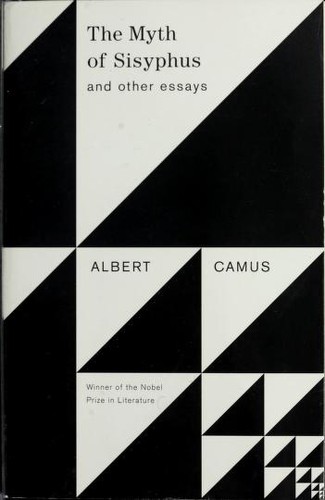
The Myth of Sisyphus
Albert Camus · 1913–1960 · Algeria / France
Originally Le Mythe de Sisyphe (French)
Why it matters
Published the same year as The Stranger, this essay asks whether life's meaninglessness makes suicide the only honest response, then answers no: push the boulder anyway. Camus's clearest statement of the absurd, ending in Sisyphus imagined happy.
At a glance
Dense philosophical argument ranging across Kierkegaard, Husserl, and Dostoevsky.
Deep dive
Camus opens a philosophical essay by naming the choice to keep living the only truly serious question philosophy has to answer, then spends the rest of the book building a case for it.
Written for readers who have finished the book. No plot recap, and nothing here is safe to read first.
Themes & symbolism
Camus defines the absurd not as a property of the world, which is merely silent, nor of the human mind, which simply wants clarity, but as the confrontation between the two: a species built to demand reasons meets a universe that offers none, and that friction, not despair itself, is what Camus calls absurd. From this definition he works out what he considers the only real philosophical question, whether that confrontation makes life worth continuing, and rules out two escapes he considers dishonest: literal suicide, which ends the confrontation by ending the person having it, and what he calls philosophical suicide, the leap into religious or metaphysical faith he accuses Kierkegaard, Chestov, and Husserl of making, using reason to argue reason all the way to a conclusion that abandons reason.
Having refused both escapes, Camus proposes instead a handful of exemplary absurd lives lived at maximum intensity without appeal to any of it mattering permanently: Don Juan, who refuses to privilege one love as eternal because eternal love is exactly the illusion the absurd has ruled out, choosing quantity of experience over any single deepened attachment; the actor, who lives a hundred lives fully across a hundred roles precisely because none of them is permanent; and the conqueror, the revolutionary who acts with total commitment while accepting that no victory he wins will outlast him. None of them hopes. All of them live harder for the lack of it.
One Must Imagine Sisyphus Happy
The essay's title figure appears only in its final pages: condemned by the gods to push a boulder up a mountain forever, watching it roll back down every time it nears the summit, Sisyphus is punishment made into pure repetition. Camus fixes on the one moment the myth usually skips past, Sisyphus's walk back down the slope to begin again, fully conscious of the pointlessness waiting for him at the top, and argues that this consciousness is itself the victory: a fate can only crush a man who does not already know it and accept it as his own. The essay's famous closing sentence, that one must imagine Sisyphus happy, is not consolation but a conclusion, scorn for the gods who devised the punishment is available to Sisyphus precisely because he has stopped hoping the boulder will ever stay at the top.
Kirilov's Logical Suicide
In a late chapter Camus turns to Kirilov, the engineer in Dostoevsky's Demons who plans to kill himself for no personal grievance at all, purely as a demonstration that a man who no longer believes in God is free to dispose of his own life as an act of pure will. Camus treats Kirilov's logic seriously rather than dismissing it, using the character to sharpen the difference between his own absurd reasoning and a suicide staged as metaphysical argument, and concludes that Kirilov has actually smuggled a kind of faith back in, treating his own death as meaningful proof of something, exactly the appeal to significance the absurd is supposed to have ruled out.