
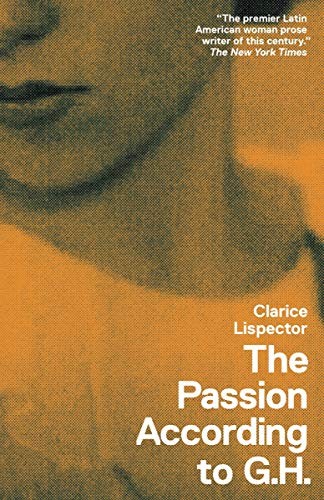
The Passion According to G.H.
Clarice Lispector · 1920–1977 · Brazil
Originally A Paixão Segundo G.H. (Portuguese)
Why it matters
A sculptor enters her maid's empty room, crushes a cockroach, and undergoes a mystical dismantling of self. Nothing happens; everything happens: the most radical interior novel in Latin American literature.
At a glance
A plotless, sentence-by-sentence mystical interior monologue with almost no external action.
Deep dive
What a wealthy woman finds when she walks into her maid's empty room expecting nothing, and why the novel insists almost nothing happens there.
Written for readers who have finished the book. No plot recap, and nothing here is safe to read first.
Themes & symbolism
G.H.'s crisis begins as a crisis of unseeing: she enters Janair's room assuming she already knows it, a maid's quarters, plain and forgettable, and instead finds it scoured to an almost geometric bareness, dominated by a charcoal wall drawing of a man, a woman, and a dog that seems to be watching her rather than the reverse. That reversal — the woman who employs and therefore believes she knows the maid discovering she has been, in some sense, the one being observed and judged all along — is the novel's opening wound to G.H.'s class and self-composure, before the cockroach ever appears.
The cockroach itself is the novel's central, deliberately revolting sacrament: primordial, pre-human matter that has existed essentially unchanged since long before language or morality or class existed to name it. When G.H. crushes it in the wardrobe door and watches the slow, visceral leakage of its innards, Lispector refuses her — and the reader — any of the ordinary outs of horror (looking away, narrating past it quickly); the prose lingers in real time because the whole passage's spiritual project depends on staying inside the disgust long enough for it to stop being disgust and start being contact with something realer than the categories G.H. has always lived inside. 'Passion' in the title carries its full etymological weight — suffering undergone, not chosen — and Lispector is quite serious that this is a religious experience, structured like a mystic's dark night, not a metaphor for one.
Lispector's Singular Voice
Clarice Lispector, born in Ukraine to a Jewish family that fled pogroms for Brazil when she was an infant, wrote in a Portuguese that Brazilian critics have called almost foreign in its syntax — dense, incantatory, willing to stall a sentence indefinitely rather than let it resolve into ordinary sense. She was as famous in Rio for her enigmatic public persona (interviewers frequently described her as looking like a witch or a visiting foreign royal) as for a body of work that includes almost no conventional plot anywhere in it; The Passion According to G.H. is simply the novel where she pushes furthest into pure interior event, a book that can be summarized in two sentences and takes two hundred pages to happen because the two sentences were never the point. Her rediscovery and canonization in English, decades after her 1977 death, has followed a trajectory strikingly similar to Machado de Assis's — a towering national reputation in Brazil taking generations to reach the world sentence by sentence, translation by translation.
The last seal: what actually happens, and why it lands the way it does.
The ending, explained
Having crushed the cockroach and spent the novel's second half in escalating, hallucinatory contemplation of its slow death and the pale matter seeping from its body, G.H. arrives at the book's central, deliberately shocking act: she brings a portion of that matter to her own mouth. It is not, in the text's own terms, an act of madness or self-punishment but a communion — an attempt to take into herself the undifferentiated, pre-moral 'thereness' of the roach's being, dissolving the boundary she has spent her comfortable life maintaining between self and other, human and animal, clean and unclean, mistress and maid. The novel ends not with G.H. returning to ordinary composure but with her describing a kind of ecstatic annihilation of ego, a passage into what she calls simply 'the it' — being prior to and beneath all the names and hierarchies she used to live by, including her own name. Lispector offers no comfortable frame for this: it reads simultaneously as the genuine mystical breakthrough G.H. experiences it as, and as a deeply upsetting negation of everything — identity, hygiene, human specialness — the reader has been trained to protect, which is precisely why the book refuses to resolve into either horror story or redemption narrative alone.
Where to go next
 Clarice Lispector · 1977The Hour of the StarLvl 7Slow burn
 Graciliano Ramos · 1938Barren LivesLvl 6Slow burn
 Rachel de Queiroz · 1930The FifteenLvl 3Medium pace
 João Guimarães Rosa · 1956The Devil to Pay in the BacklandsLvl 9Slow burn
 Jorge Amado · 1958Gabriela, Clove and CinnamonLvl 3Fast paced
 Virginia Woolf · 1925Mrs DallowayLvl 7Slow burn