
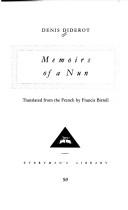
The Nun
Denis Diderot · 1713–1784 · France
Originally La Religieuse (French)
Why it matters
A young woman forced into a convent narrates the cruelty and predation she finds behind its walls. Written as a hoax to lure a friend back to Paris, it became one of the Enlightenment's fiercest attacks on religious institutions.
At a glance
Direct confessional prose, though the institutional cruelty is unrelenting.
Deep dive
Diderot's friends invented a persecuted nun's letters purely to lure an absent friend back to Paris, and what started as a private joke on him grew into one of the era's angriest arguments against forced religious vows.
Written for readers who have finished the book. No plot recap, and nothing here is safe to read first.
Themes & symbolism
Suzanne Simonin narrates her own coerced entry into convent life with the plain, cumulative persuasiveness of someone building a legal case rather than performing suffering for effect, and Diderot uses that restraint deliberately: the horror of watching a family pressure an illegitimate daughter into vows she never wanted lands harder for being reported so calmly. Her passage through three different convents lets Diderot vary the argument rather than repeat it. One superior, Sister Sainte-Christine, punishes Suzanne's resistance with escalating, almost theatrical cruelty and deprivation, while a later one develops an obsessive, physically charged attachment to her that the text renders with unusual directness for its period, desire coded as spiritual devotion right up until it visibly isn't.
Diderot's target isn't faith itself but the specific institutional machinery that converts economic convenience, a family avoiding splitting an inheritance among three daughters, into a lifelong vow no court will let a grown woman revoke. Suzanne's repeated legal appeals to have her vows annulled fail not because her case is weak but because the institutions reviewing it have every incentive to uphold each other, and that structural indifference, more than any single cruel superior, is what the novel keeps insisting is the real crime: a system that can absorb any individual atrocity as long as its own authority stays intact.
A Hoax That Outgrew the Man It Was Written For
Diderot and his circle invented Suzanne's letters as an elaborate prank on the Marquis de Croismare, a friend who had once championed a real nun's legal fight to leave her convent, hoping his sympathy for a fictional case would draw him back to Paris. Croismare fell for it completely, offering the invented Suzanne employment rather than the trip to Paris the conspirators wanted, forcing Diderot to keep the fiction alive with further forged letters explaining her sudden illness, and he only learned the truth years later from one of the other conspirators, by which point he reportedly found the whole elaborate deception genuinely funny. Diderot kept expanding the letters into the full novel anyway, publishing after his own death, so that what began purely as an inside joke on one credulous friend became the era's most direct literary indictment of forced monastic vows.
The last seal: what actually happens, and why it lands the way it does.
The ending, explained
Suzanne finally escapes convent life with help from a sympathetic priest, Dom Morel, who has no genuine religious vocation of his own, only to discover during their flight to Paris that his help came with an expectation she never agreed to, and he assaults her honor on the road. Alone in the city with no protection and no resources, she drifts briefly through a house that turns out to be a brothel before escaping again and finding work as a laundress, still writing to the Marquis in hopes of securing a respectable position. Her letters simply stop. A closing exchange between the Marquis and a lawyer handling her affairs implies she fell ill and died in that obscurity, the novel's bleakest possible argument that escaping the convent's specific cruelty delivered her only into a world with no real place for a woman in her position either.
Where to go next
 Denis Diderot · 1796Jacques the FatalistLvl 6Slow burn
 Laurence Sterne · 1759The Life and Opinions of Tristram Shandy, GentlemanLvl 9Slow burn
 Voltaire · 1759CandideLvl 3Fast paced
 Abbé Prévost · 1731Manon LescautLvl 4Fast paced
 Pierre Choderlos de Laclos · 1782Les Liaisons DangereusesLvl 5Medium pace
 Jonathan Swift · 1726Gulliver's TravelsLvl 5Medium pace