
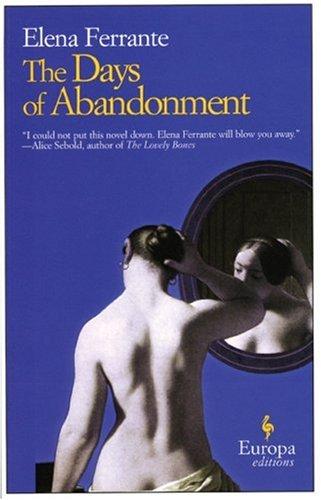
The Days of Abandonment
Elena Ferrante · b. 1943 · Italy
Originally I giorni dell'abbandono (Italian) · translated by Ann Goldstein
Why it matters
A wife's collapse after her husband leaves, narrated at scalding proximity: one locked door becomes a horror story of the self. Ferrante's rage before the Quartet: short, brutal, unforgettable.
At a glance
Intense, claustrophobic first-person voice, but syntactically direct.
Deep dive
A wife's husband walks out over breakfast with barely an explanation, and Ferrante spends the rest of the novel refusing every convention that would soften what happens to a mind left alone with that kind of rage.
Written for readers who have finished the book. No plot recap, and nothing here is safe to read first.
Themes & symbolism
Olga's husband Mario leaves abruptly, offering only the thinnest explanation before the novel makes clear he has been sustaining an affair, and Ferrante's real subject is not the marriage's collapse but what Olga does with the identity she had built entirely around being a wife and mother once that structure is removed without warning: the 'poverella,' the abandoned, pitiable woman Olga remembers from her own Neapolitan childhood, becomes the terrifying template Olga fears repeating and, for long stretches of the novel, cannot stop herself from embodying, right down to physically deteriorating in front of her own children.
The apartment itself, its jammed door lock, a dying dog, two children needing care Olga can barely provide during her worst days, becomes the novel's pressure chamber: Ferrante confines nearly the entire back half of the book to a single sweltering apartment over what amounts to one catastrophic day, and the claustrophobia is deliberate, denying Olga, and the reader, any escape from the raw physical experience of her unraveling. This isn't depression rendered elegantly from a safe narrative distance; it's rendered from inside the collapse, with all its ugliness, incompetence, and genuine danger to the children left intact.
Otto, the family dog whose death runs parallel to Olga's psychological low point, and the graphic, unglamorous physical detail Ferrante gives to bodily failure throughout the novel, vomit, sweat, blocked doors, a child's fever, work against any reading of Olga's crisis as simply metaphorical female rage. Ferrante insists on the specifically bodily, unbeautiful texture of a breakdown, refusing the novel any of the lyrical cover that discussions of women's anger and abandonment often reach for, which is precisely why the book landed as such a shock to readers used to more decorous treatments of the same material.
Rage Without a Redemptive Frame
Ferrante published the novel in 2002, years before the Neapolitan Quartet made her an international phenomenon, and it already displays the same refusal that would define her later work: no interest in making Olga likable or her rage productive. Olga's worst behavior, violence toward Mario's new lover glimpsed in public, dangerous neglect of her children during her collapse, sexual encounters pursued out of something closer to self-punishment than desire, are presented without apology or narrative punishment calibrated to satisfy a reader's sense of justice. The novel's power comes specifically from that refusal to redeem Olga on any schedule faster than the one her own mind actually manages, which is slow, uneven, and never fully complete by the book's end.
The last seal: what actually happens, and why it lands the way it does.
The ending, explained
Olga's lowest point arrives during the single overheated day when she finds herself locked inside the apartment with her sick son, her dying dog, and no working phone, cut off from help while her own grip on coherent thought and time visibly slips, a sequence Ferrante renders with near-hallucinatory disorientation before Olga claws her way back to enough functional clarity to get her son to a hospital. That crisis becomes the novel's actual turning point rather than any reconciliation with Mario, who remains peripheral and unredeemed throughout; Olga's real recovery is measured against herself, not against getting her husband back. In the novel's final pages, months later, Olga has neither forgiven Mario nor collapsed permanently into the poverella she feared becoming; she has instead settled into something more ambiguous and harder-won, a life rebuilt on her own uncertain terms, with a tentative new relationship and a wary, clear-eyed sense that whatever stability she has regained is provisional rather than restored to some prior wholeness.
Where to go next
 Elena Ferrante · 2011My Brilliant FriendLvl 3Fast paced
 Elena Ferrante · 2012The Story of a New NameLvl 3Fast pacedElena Ferrante · 2013Those Who Leave and Those Who StayLvl 4Fast pacedElena Ferrante · 2014The Story of the Lost ChildLvl 4Fast paced
 Antonio Tabucchi · 1994Pereira MaintainsLvl 4Medium pace
 Jeffrey Eugenides · 2002MiddlesexLvl 6Medium pace