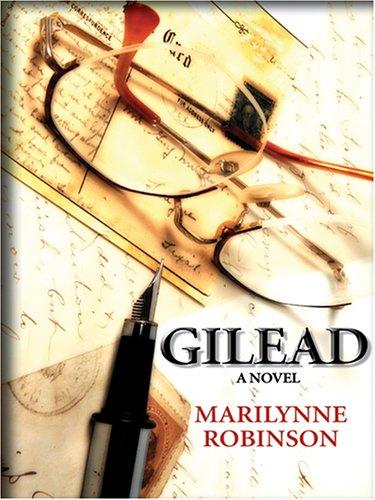
Gilead
Marilynne Robinson · b. 1943 · United States
Why it matters
An aging Iowa preacher writes a letter to the young son he won't live to raise. Robinson's Pulitzer winner is a luminous meditation on mortality, inheritance, forgiveness, and ordinary light.
At a glance
A meandering, meditative letter form with minimal plot rewards patient reading.
Deep dive
A dying preacher spends his last letter working out whether he can forgive the one man who reminds him of his own worst instincts.
Written for readers who have finished the book. No plot recap, and nothing here is safe to read first.
Themes & symbolism
Ames's family carries three generations of American religious conscience in open conflict: his grandfather, a one-eyed, gun-carrying abolitionist preacher who rode with John Brown and saw visions of Christ in chains, versus his father's exhausted, doctrinaire pacifism, forged in reaction to that violence. Ames himself, gentler than either, spends the novel trying to locate a faith that neither glorifies righteous bloodshed nor retreats entirely from the world — the Kansas-Iowa axis of the book is quite literally the geography of Bleeding Kansas rewritten as inherited temperament.
The novel's theology is radically this-worldly: grace shows up as light on water, a baseball thrown underhand, the smell of his son's hair, ordinary sensory abundance treated as sacrament rather than metaphor, echoing Feuerbach (whom Ames has read and half-disagrees with) more than orthodox doctrine. Jack Boughton, his best friend's prodigal namesake son, is the letter's real engine — a man Ames has resented for decades out of something close to envy and suspicion, whose secret marriage to a Black woman, Della, and mixed-race son force Ames to confront his own unexamined smallness before he can finally offer the blessing the book has been withholding. Ames's own late marriage and unexpected fatherhood, arriving after decades of solitary widowhood, sharpen the stakes of that reckoning — a man given a second, undeserved chance at love has less excuse than most for withholding a second chance from someone else.
The Letter as Deathbed Confession
Robinson commits entirely to the epistolary form — Ames writing to the son who won't remember him, working in real time through memory, digression, and revision exactly as a dying man actually would, correcting himself, doubling back, admitting things he wasn't planning to admit. The form makes the reader complicit in a confidence rather than a plotted revelation: we watch Ames talk himself, sentence by sentence, out of resentment and into grace, which is a much harder thing for a novel to dramatize than an act of violence, and the reason the book's quiet pace is the whole point rather than a limitation.
A Calvinism Worth Defending
Robinson has written at length, in essays outside the novel, against the popular caricature of Calvinism as joyless and punitive, and Gilead is that argument made narrative: Ames's theology is intellectually rigorous — he reads Feuerbach and Barth seriously, on their own terms, rather than dismissing them — and arrives at wonder rather than austerity. The novel's Pulitzer win in 2005 registered as a rebuke to the assumption that serious literary fiction had to treat faith ironically or from the outside; Robinson writes belief from within, as a mind actually working, which is a rarer and harder achievement than skepticism, and one she returned to from Lila's and Jack's own vantage points in the loosely linked Gilead novels that followed.
The last seal: what actually happens, and why it lands the way it does.
The ending, explained
Having spent the letter circling his jealousy and mistrust of Jack, Ames finally learns the truth behind the young man's furtive visits: Jack has a wife and son he loves in Missouri, unrecognized because interracial marriage there is illegal and dangerous, and he had come home hoping — never quite finding the nerve to ask — for Ames's blessing before leaving Gilead for good. Ames gives it, laying hands on him in something like a benediction, and in doing so releases both the specific old grievance and, more broadly, his fear that grace has limits. The letter closes on Ames's meditations on mortality and ordinary radiance — dust, light, the courage it takes to sleep peacefully — ending not on plot but on acceptance, a benediction addressed as much to the reader as to his unborn-into-memory son.