
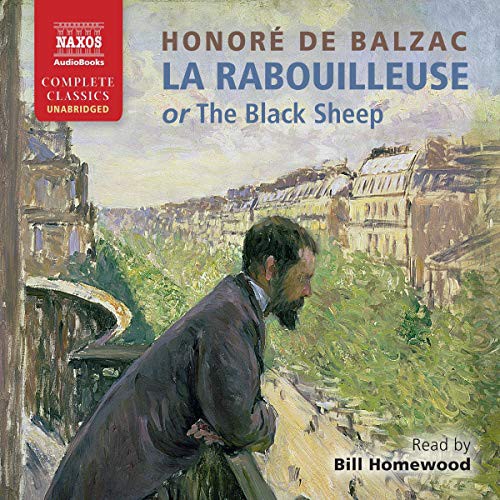
The Black Sheep
Honoré de Balzac · 1799–1850 · France
Originally La Rabouilleuse (French)
Why it matters
Two brothers, one a gifted wastrel and one a plodding provincial, circle their dying uncle's fortune while the peasant girl who controls his household plays them against each other: Balzac's cruelest inheritance plot, with barely a decent character in sight.
At a glance
Wide provincial cast and interlocking financial schemes require sustained tracking.
Deep dive
Two brothers circle their rich, senile uncle's fortune while the peasant woman running his household decides who actually gets to inherit it, and Balzac doesn't give the reader a single person in the whole book worth rooting for.
Written for readers who have finished the book. No plot recap, and nothing here is safe to read first.
Themes & symbolism
Flore Brazier, nicknamed 'la Rabouilleuse' for the childhood job of muddying streams to catch crayfish, is taken in as a girl by old Doctor Rouget and rises to become housekeeper, mistress, and eventually the near-total controller of first his estate and later his son Jean-Jacques Rouget's entire fortune, all without ever holding any formal legal standing in either household. Balzac uses her to show how real domestic power moved in provincial France when the law excluded women from owning much of anything directly: through leverage over an old man's habits and appetites rather than through any title a court would recognize.
Philippe Bridau, the title's nominal black sheep, is a decorated Napoleonic officer whose military glamour turns out to mask something closer to a moral void: he abandons his own mother to poverty, sabotages his brother Joseph's modest chances at the family inheritance, and grows steadily more ruthless as the novel goes on rather than redeeming himself through hardship the way an earlier Balzac hero might. Joseph, the struggling but genuinely talented painter, is decent by comparison but no match for Philippe's calculation, and Balzac is careful never to let goodness look like it stands a real chance in Issoudun.
Max Gilet, Flore's other lover and co-conspirator, runs with a local gang of idle young toughs who terrorize the town for entertainment, giving the novel a specifically provincial menace distinct from the glamorous Parisian corruption of Balzac's capital-set novels: no salons, no grand ambition, just small-town appetite scaled up to whatever size the local fortune allows.
A Title That Refuses to Name One Villain
Philippe is the character everyone in the book calls the black sheep, but Balzac spreads the actual moral rot across nearly the entire cast: a mother whose blind favoritism for her worse son actively enables him, a more sympathetic brother whose own resentments are never quite innocent either, and Flore and Max's predation on a defenseless old man treated with the same clinical interest as anyone else's scheming. Unlike Père Goriot's more legible sentimental tragedy, this novel keeps every character implicated, refusing the reader a clean scorecard of who deserves what.
The last seal: what actually happens, and why it lands the way it does.
The ending, explained
Philippe engineers Max's death in a rigged duel, manoeuvres Flore into marrying him instead once Jean-Jacques dies and leaves her the fortune, then effectively imprisons and neglects his new wife until she dies too, leaving him in sole control of everything. He briefly regains military rank and something like respectability on the strength of the money, but dies ignobly fighting in Algeria, his body left unclaimed, his crimes catching up with him in a different uniform than the one he'd used to charm his way into the house. Joseph inherits only a small legacy but keeps a modest, genuine domestic happiness and belated recognition as a painter, and the novel's closing irony is that Philippe's respectable fortune and Max's gang violence turn out equally hollow and equally short-lived.
Where to go next
 Honoré de Balzac · 1831The Wild Ass's SkinLvl 5Fast paced
 Honoré de Balzac · 1832Colonel ChabertLvl 3Medium pace
 Honoré de Balzac · 1833Eugénie GrandetLvl 3Medium pace
 Honoré de Balzac · 1835Père GoriotLvl 4Medium pace
 Honoré de Balzac · 1837Lost IllusionsLvl 5Medium pace
 Honoré de Balzac · 1846Cousin BetteLvl 5Medium pace