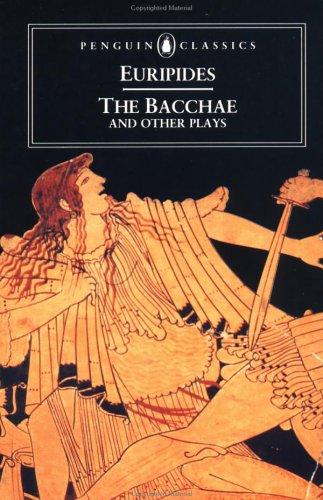
The Bacchae
Euripides · 480–406 BCE · Greece
Originally Βάκχαι (Ancient Greek)
Why it matters
A king tries to suppress the ecstatic cult of Dionysus and is torn apart by its frenzied worshippers, led by his own mother. Euripides' terrifying last play: what happens when reason denies the irrational, staged as the god's own revenge.
At a glance
Ecstatic choral passages and a deliberately ambiguous theology resist tidy interpretation.
Deep dive
A king who refuses to recognize his own cousin as a god spends the play systematically underestimating exactly what that god is prepared to do to Thebes, and to the king's own household, to be believed.
Written for readers who have finished the book. No plot recap, and nothing here is safe to read first.
Themes & symbolism
Dionysus arrives in Thebes disguised as a mortal follower of his own cult specifically to punish the city that denies his divinity, including his aunts, who spread the rumor that his mother Semele lied about being impregnated by Zeus, and King Pentheus, his cousin, who represents that denial in its most rigid, state-authorized form. Euripides builds the entire tragedy around a confrontation between two ways of governing a self: Pentheus's obsessive control, his horror at the Bacchic revelry of women loosed into the mountains, and Dionysus's cult of ecstatic dissolution, frenzy, wine, and the deliberate surrender of individual restraint to something larger and less containable.
Pentheus's fascination with the very revelry he claims to find obscene, his eventual willingness to dress as a woman and spy on the maenads at Dionysus's suggestion, exposes the tragedy's darkest psychological insight: repression and desire are not opposites in this play but the same energy pointed in different directions, and Pentheus's downfall comes not from indulging his curiosity too little but from having no framework, once Dionysus offers him one, for managing it at all. Euripides makes the god himself the one who engineers Pentheus's humiliating disguise, turning the king's own suppressed fascination into the mechanism of his destruction.
Agave's participation in her son's death, torn apart by the frenzied maenads including his own mother, who in her god-induced madness believes she has killed a mountain lion, gives the play its most extreme statement about what happens when a community denies a genuine, uncontainable force in the world rather than finding some sustainable accommodation with it. Euripides doesn't stage Dionysus as simply right and Pentheus as simply wrong; the god's vengeance is disproportionate, even monstrous, and the play's late-career skepticism about the Olympian order it depicts leaves the audience with a religion that demands recognition on pain of annihilation rather than one that offers comfort.
Euripides's Last, Strangest Play
The Bacchae was composed in Euripides's final years in Macedon, away from Athens, and produced posthumously around 405 BCE, after a career spent needling Athenian orthodoxy with skeptical, rationalist treatments of myth and the gods. That makes its subject matter genuinely startling: rather than continuing to question divine authority, Euripides's last surviving play stages a god whose reality the human characters deny at their own catastrophic peril, closer to religious horror than rationalist critique. Scholars have long debated whether the play represents a late-life religious conversion, a final irony aimed at an audience that would take the god's brutality as vindication rather than warning, or simply Euripides refusing, to the end, to resolve the tension between reason and ecstatic faith that runs through his whole body of work.
The last seal: what actually happens, and why it lands the way it does.
The ending, explained
Agave returns to Thebes in triumphant, still-maddened procession carrying what she believes is a lion's severed head, only to have her father Cadmus gently, mercilessly walk her back to clarity moment by moment until she recognizes the head as her own son Pentheus's, torn apart by her own hands. Euripides stages the recognition with unbearable patience, refusing to let Agave's horror arrive all at once, which makes the god's punishment land as something closer to torture than justice. Dionysus appears in the play's final movement not to offer comfort but to confirm, coldly, that the entire catastrophe was deserved punishment for Thebes's refusal to honor him, exiling Cadmus and Agave from the city they built. The play closes without any restoration of order, only a family destroyed and a god whose case for his own worship has been made through spectacle rather than mercy, leaving the audience to decide for itself whether that is what divine justice is actually supposed to look like.