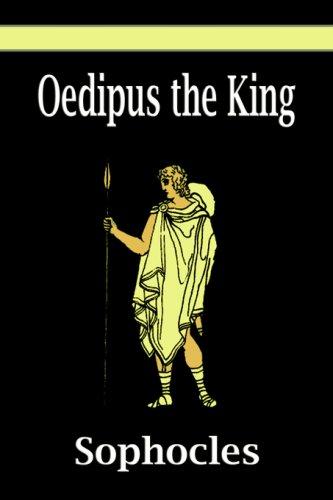
Oedipus Rex
Sophocles · 496–406 BCE · Greece
Originally Οἰδίπους Τύραννος (Ancient Greek)
Why it matters
A king vows to hunt down whoever is responsible for the plague on his city, chasing the investigation with a relentlessness that will not let him stop even as the clues start pointing somewhere he never expected. Aristotle's model tragedy and drama's most perfect plot: every step toward the truth taken freely, every step foreordained.
At a glance
Compact and propulsive; only the choral odes and mythic backstory need footnotes.
Deep dive
Every step the hero takes toward solving the mystery is a step the audience already knows will destroy him, and Sophocles builds the whole play out of that gap.
Written for readers who have finished the book. No plot recap, and nothing here is safe to read first.
Themes & symbolism
Sophocles builds Oedipus Rex on a dramatic irony so total it becomes the play's actual content: the Athenian audience arrived already knowing the myth, so Oedipus's confident, methodical investigation of Laius's murder is watched not as suspense but as a man sprinting toward a cliff he can't see. Every piece of evidence he gathers to prove someone else's guilt in fact convicts him, and his fury at Tiresias and later at Creon for supposedly conspiring against him reads, on a second look, as fury at the truth itself for refusing to stay hidden. The play's famous engineering, its unity of the reversal (peripeteia) and the recognition (anagnorisis) into a single stroke, is what Aristotle later held up as tragedy's ideal shape precisely because Sophocles makes the discovery and the catastrophe the same event.
Sight and blindness run through the play as its central metaphor and its cruelest joke: Tiresias, physically blind, sees the truth instantly and is disbelieved, while Oedipus, sighted and seemingly rational, is blind to what's directly in front of him until the facts leave him no room left to hide from them. The play refuses to let fate and responsibility cancel each other out. Oedipus did everything a prophecy said he would, but he also chose, freely and in good faith, to flee Corinth to avoid it, to kill an arrogant stranger at a crossroads, to marry the widowed queen who'd saved his city; Sophocles insists on holding him accountable for choices made in total ignorance, which is exactly what makes the ending's self-punishment feel less like a formality than like the only response left to a man who prized his own clear-sightedness above everything.
The Model Tragedy
Aristotle built much of the Poetics' argument for what makes tragedy work directly around this play, and it's easy to see why: it delivers reversal and recognition in the same instant rather than staggering them across separate scenes, its hero's downfall comes from a specific error in judgment rather than simple villainy, and it produces the fear and pity Aristotle considered tragedy's proper effect precisely because Oedipus is neither wholly wicked nor wholly innocent, just a capable, well-intentioned ruler undone by the very diligence that makes him admirable. Every clue he chases down out of civic responsibility tightens the noose further, so the play's celebrated construction isn't decoration on top of the story, it's the mechanism that makes the story's cruelty feel inevitable rather than arbitrary.
The last seal: what actually happens, and why it lands the way it does.
The ending, explained
Once the shepherd's testimony closes the last gap in the story, Jocasta disappears into the palace and hangs herself. Oedipus finds her body, takes the golden pins from her dress, and blinds himself with them, declaring that eyes that failed to see the truth for so long don't deserve to look at the world, or at his own children, any longer. He asks Creon to exile him, invoking the very sentence he himself had pronounced on Laius's killer before knowing it was him, and takes on the punishment willingly even though the crimes were fated and unknowing. The play ends without resolving his exile, Creon simply assuming provisional control, which keeps the emphasis on Oedipus's self-inflicted verdict rather than any external judgment: the man who prided himself on seeing clearly enacts, quite literally, his own blindness as the truest possible penalty.