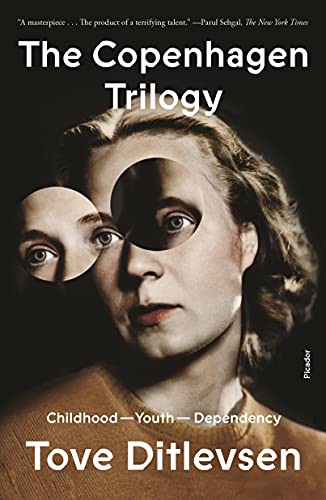
The Copenhagen Trilogy
Tove Ditlevsen · 1917–1976 · Denmark
Originally The Copenhagen Trilogy (Danish)
Why it matters
Childhood, Youth, and Dependency: a working-class Copenhagen girl becomes a poet and an addict, told in cool, luminous prose. Autofiction decades before the term: the making of a writer and the unmaking of a woman.
At a glance
Clear, cool, confessional prose despite its harrowing subject matter.
Deep dive
The flatness of the prose is the argument — why cool, unhurried reportage does more damage than a confession ever could.
Written for readers who have finished the book. No plot recap, and nothing here is safe to read first.
Themes & symbolism
Ditlevsen's style is the trilogy's real innovation: addiction, self-destruction, and suicidal despair are narrated in the same unhurried, plain register as a walk to school or a first kiss, and that refusal to modulate tone is what makes Dependency so unbearable rather than merely sad. A more conventionally "confessional" memoir would signal horror through rising language, inviting the reader's catharsis and, with it, a comfortable distance. Ditlevsen withholds that signal. The prose stays level while the events do not, which puts the reader in the position of noticing the gap themselves rather than being guided to feel it — a technique decades ahead of what would later be branded autofiction.
The men in Ditlevsen's life — the much older editor Viggo F. Møller, who publishes her first poems inside a starkly unequal relationship, and later the doctor Carl, who supplies the opioids that nearly destroy her — are escalating versions of the same trade. Each offers her something she needs (literary legitimacy, relief from pain) in exchange for control over her body or her voice, and Dependency simply literalizes a pattern Childhood and Youth already established: for a working-class girl determined to become a writer, access to the world she wants keeps arriving through men who expect payment she didn't know she was agreeing to.
Three Titles, One Descent
Each volume has its own register even as the flat style holds constant across all three: Childhood carries a fairy-tale menace, its dangers half-glimpsed through a child's incomplete understanding; Youth is restless and hungry, propelled by an ambition the girl can feel but can't yet name or defend to anyone around her; Dependency turns clinical, its sentences describing withdrawal and relapse with the same detachment a doctor might use, which is exactly the irony — the book about losing control is the most controlled in its telling. The title Dependency does double duty, naming both the opioid addiction and the underlying pattern of relying on men for the means to become herself.
An Ambition Nobody Had a Word For
Part of what makes Childhood and Youth so quietly devastating is that Ditlevsen's ambition to become a poet has no vocabulary in the world she's born into — her family and class assume, correctly by their own logic, that a girl like her becomes a factory worker or a wife, not a writer. The trilogy doesn't stage this as a dramatic rebellion; it stages it as a private, almost embarrassing conviction she has to protect from people who love her, which makes every small step toward publication feel both triumphant and slightly illicit.
The last seal: what actually happens, and why it lands the way it does.
The ending, explained
Dependency closes with Ditlevsen achieving a fragile sobriety after repeated institutionalization and withdrawal — hard-won, but the prose refuses to inflate it into triumph. There's no declaration of a cure, just a quieter, more stable footing than the one she nearly died on. Readers who bring outside knowledge of Ditlevsen's biography — she died by suicide in Copenhagen in 1976, years after the trilogy's original publication — inevitably read this ending as provisional rather than secure, and the book's own flat, unsentimental register seems to invite exactly that caution rather than a settled happy ending. The trilogy never asks to be read against that later fact, but it doesn't discourage it either — the same reportorial calm that renders the addiction so plainly leaves the recovery just as unadorned, offering relief without insisting on permanence.