
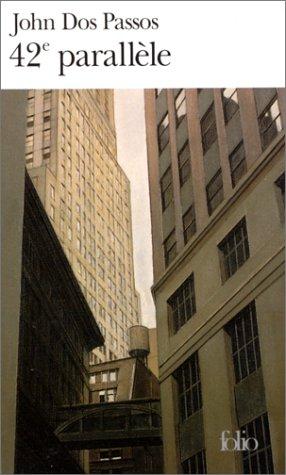
The 42nd Parallel
John Dos Passos · 1896–1970 · USA
Why it matters
The opening volume of the U.S.A. trilogy, interrupting a dozen fictional Americans' lives with 'Newsreel' collages of real headlines and stream-of-consciousness 'Camera Eye' interludes. Dos Passos's collective portrait of a nation industrializing itself into war and disillusionment.
At a glance
Interlocking documentary collage, multiple narrators, and no single throughline demand sustained attention.
Deep dive
How Dos Passos builds the opening volume of the U.S.A. trilogy out of five strangers' lives, real headlines, and the fragmented private memory of a narrator who never gets a name.
Written for readers who have finished the book. No plot recap, and nothing here is safe to read first.
Themes & symbolism
The 42nd Parallel tracks five invented Americans, Fainy Mac McCreary drifting through printing shops and IWW halls, Janey Williams typing her way into a Washington secretarial career, J. Ward Moorehouse angling from small-town ad man toward corporate power, Eleanor Stoddard chasing refinement out of Chicago, Charley Anderson tinkering with engines, without ever letting their paths intersect for more than a scene or two. Dos Passos isn't building toward a plot where these lives converge; he's building a cross-section of the country at the moment American capital, labor, and war were about to collide, and the lack of a single throughline is the argument, not a structural flaw.
Between the character chapters, Dos Passos inserts three other kinds of text: Newsreel collages of real headlines, advertising slogans, and popular song lyrics lifted verbatim from the period; Camera Eye sections of unpunctuated, stream-of-consciousness memory drawn from Dos Passos's own privileged, rootless childhood; and short biographical portraits of real figures, Eugene Debs, Andrew Carnegie, Thomas Edison, Luther Burbank, written in a clipped, ironic register that sits the era's official heroes against the invented characters' much smaller ambitions.
Debs Against Carnegie, or the Two Americas
The real-figure portraits fall on opposite sides of a divide the novel never states directly: Eugene Debs organizing railway workers and running for president from a jail cell, against Andrew Carnegie converting a ruthless steel monopoly into a public image as a library-building philanthropist. Dos Passos writes both men's biographies in the same flat, fact-dense prose, refusing either the sneer or the tribute, and lets the juxtaposition make the case his fictional characters are all, in their smaller ways, choosing between.
The Camera Eye as the Novel's Only Confession
Every other voice in the book, fictional or historical, arrives filtered through documentary distance, but the Camera Eye sections drop that distance entirely: fragmentary, unpunctuated childhood memories that read as close to unmediated interior monologue as Dos Passos ever published. Critics have long read them as the novel's real narrator finally speaking in his own unguarded voice, a single privileged American consciousness watching the century's collective story from just outside it.
Where to go next
 John Dos Passos · 1925Manhattan TransferLvl 6Medium pace
 James Joyce · 1914DublinersLvl 3Slow burn
 Eyvind Johnson · 1946Return to IthacaLvl 6Medium pace
 Djuna Barnes · 1936NightwoodLvl 9Slow burn
 Patrick White · 1957VossLvl 8Slow burn
 Gertrude Stein · 1933The Autobiography of Alice B. ToklasLvl 5Medium pace