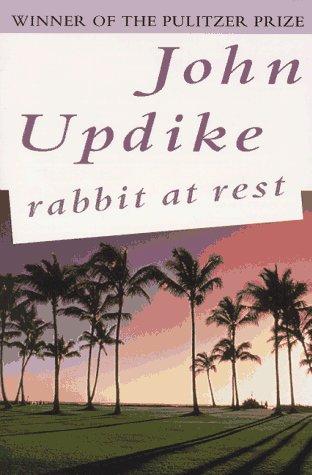
Rabbit at Rest
John Updike · 1932–2009 · United States
Why it matters
Harry Angstrom's heart, body, and decades of appetite finally give out in Florida retirement, closing the tetralogy that tracked one American man across four decades. Updike's second Rabbit Pulitzer completed literature's most exhaustive study of ordinary decline.
At a glance
Long, meditative sentences slow a novel built around physical decline.
Deep dive
The fourth and final Angstrom novel, in which thirty years of American appetite finally catch up with one failing heart.
Written for readers who have finished the book. No plot recap, and nothing here is safe to read first.
Themes & symbolism
Harry Angstrom's body — overweight, arrhythmic, subsisting on junk food and denial — is Updike's most direct late metaphor for the country itself at the end of the Reagan era: a Toyota dealership funded by dirty money, a son sliding into cocaine addiction and embezzlement, a culture of consumption finally presenting its bill all at once. The novel is relentless about connecting Harry's private physical decline to a specifically American excess, without ever losing sight of Harry as a particular, fully imagined man rather than a symbol wearing a body.
Nelson's addiction and theft from the dealership function as the next generation's version of Harry's own lifelong pattern of appetite and flight — established across the whole tetralogy by Rabbit, Run's opening abandonment of his pregnant wife — except Nelson has none of his father's physical vitality or luck to cushion the fall, which makes his arc read less like rebellion against Harry than like inheritance, appetite passed down a generation with the charm and resilience left out.
Janice, dismissed for three prior novels as ineffectual and passive, spends this final volume quietly assembling real competence — in real estate, in the family business, in finally confronting Harry directly — and Updike uses her late emergence as the series' closest thing to a corrective: the marriage's actual balance of power was always more available to her than Harry, or the earlier novels' close focus on his consciousness, allowed readers to see.
Closing a Twenty-Year Project
Written roughly a decade apart across four novels spanning 1960 to 1990, the Rabbit series functioned as Updike's real-time chronicle of postwar American middle-class life, each book set close to its year of publication and absorbing the decade's texture — Vietnam, the moon landing, the energy crisis, and here, the Gulf War buildup and Reagan-era financial excess — directly into Harry's immediate world. Rabbit at Rest won Updike his second Pulitzer for the series, and its unhurried, digressive late style, willing to sit inside Harry's physical decline in unsparing physiological detail, reads as a deliberate final reckoning with a character Updike had spent three decades refusing to either fully redeem or fully condemn.
The last seal: what actually happens, and why it lands the way it does.
The ending, explained
After a first, near-fatal heart attack sailing with his granddaughter Judy, Harry ignores his doctors' warnings and returns to his old adolescent habit of playing pickup basketball, this time against a neighborhood teenager, driven by the same reflexive need to prove his body still works that has defined him since the series' first pages. He collapses afterward and this time doesn't recover; at the hospital, with Nelson begging him not to die, Harry's dying words — 'Well, Nelson, all I can tell you is, it isn't so bad' — refuse either despair or false comfort, delivered in exactly the flat, undercutting register he's used his whole life to deflect real feeling. The novel's actual final word, reported rather than spoken to anyone in particular as his consciousness fades, is 'Enough' — a verdict that reads simultaneously as exhaustion, acceptance, and the closest thing to peace this restless, appetite-driven man is capable of reaching.