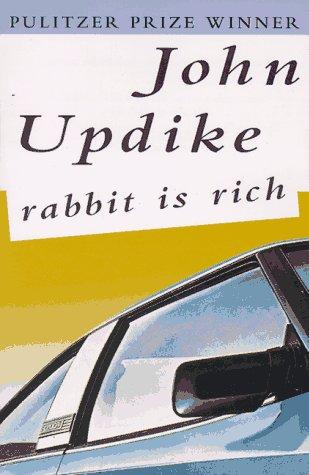
Rabbit Is Rich
John Updike · 1932–2009 · United States
Why it matters
Harry Angstrom, now a prosperous Toyota dealer in late-1970s stagflation, coasts through affluence and creeping mortality with the same restless hunger that once made him run. The third Rabbit novel won Updike his first Pulitzer and National Book Award together.
At a glance
Dense, sensuous prose continues Updike's richly detailed suburban interiority.
Deep dive
Harry Angstrom finally gets rich just as the country runs out of gas, and discovers that arrival feels a lot like standing still.
Written for readers who have finished the book. No plot recap, and nothing here is safe to read first.
Themes & symbolism
Harry buys Krugerrands throughout the novel, hoarding gold coins against an inflation and energy-crisis apocalypse he half-relishes imagining — a middle-aged man converting the restlessness that once sent him running out of a marriage (in Rabbit, Run) into something he can lock in a safe-deposit box. Where the young Harry fled, the prosperous Harry hedges; the coins are less an investment than a talisman, magic thinking dressed as fiscal prudence, and Updike lets the gas lines snaking past the Toyota lot supply the dread that Harry's own comfortable interior keeps trying to wave off.
The novel is relentlessly physical about what 'rich' costs and buys: Harry himself has thickened, settled, gone soft with plenty, and Updike lavishes the same appetite on steaks, golf swings, and showroom chrome that earlier Rabbit books spent on flight and sex. Nelson's return home, sullen and entitled, plays as inheritance rather than rebellion — the son repeating the father's old restlessness inside a house the father now owns outright, a quiet argument that American appetite doesn't resolve across generations, it just changes address.
Mortality runs underneath all of it as a low, constant hum rather than a plot event: Harry counts his own pulse, eyes younger men with envy and dread, and treats the dealership itself — his late father-in-law's, inherited rather than built — as proof that even arrival in America comes secondhand, passed down instead of earned outright. The stagflation backdrop isn't incidental scenery; a whole country hoarding gas and gold in 1979 becomes the collective version of Harry's private hedge against decline, an entire middle class buying insurance against a future it can feel closing in.
The Swap That Doesn't Happen
The Caribbean vacation builds for a hundred pages toward a partner-swap Harry has fantasized about for years, centered on his neighbor Cindy Murkett — and Updike deflates it at the exact moment of arrival, pairing Harry off in the dark with Thelma instead. It's the novel's whole comic method in miniature: appetite gestured toward relentlessly, rarely delivered as imagined, the gap between Harry's fantasy life and his actual one supplying most of the book's irony without ever curdling into punishment.
Prose for the Unheroic
Updike spends virtuoso sentence-level attention on material that has no business earning it — a golf drive, a showroom floor, the particular give of a leather car seat — treating middle-class consumer contentment with the same scrutiny other novelists reserve for tragedy. It won Updike his first Pulitzer and National Book Award together, and it's also the entry in the tetralogy most accused of being seduced by its own subject, luxuriating in Harry's complacency more than it interrogates it.
The last seal: what actually happens, and why it lands the way it does.
The ending, explained
Nelson and his wife Pru have their daughter, Judy, and the novel closes with Harry at the hospital holding his newborn granddaughter — the anxious, appetite-driven man who spent three earlier decades running toward something quieted, for a moment, by an infant's grip on his finger. There's no confrontation, no reckoning, just continuity: the American hunger for more passed down another generation without comment. It's a deliberately anticlimactic close for a novel titled Rich — Harry has everything the title promises and the book ends on nothing more than a held breath, materially secure and interior blank.