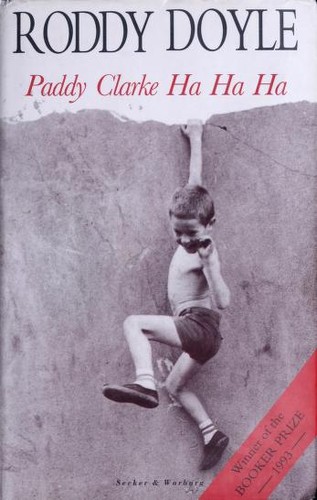
Paddy Clarke Ha Ha Ha
Roddy Doyle · b. 1958 · Ireland
Why it matters
Ten-year-old Paddy rules Barrytown's building sites in 1968, until the sounds through the wall tell him his parents' marriage is ending. The Booker winner that renders childhood from the inside: its cruelty, its logic, its helplessness before adult grief.
At a glance
Plotless child's-eye vignettes whose emotional architecture assembles gradually.
Deep dive
Why the funniest voice in the novel is also its least reliable witness, and what Paddy's obsessive boyhood games are actually protecting him from noticing.
Written for readers who have finished the book. No plot recap, and nothing here is safe to read first.
Themes & symbolism
Doyle commits entirely to Paddy's ten-year-old register — present-tense, associative, gleefully cruel, hopping between a burned cat, a game of rules-heavy 'football,' and a friend's terrifying da without any adult framing to soften or explain — and the risk pays off because the gaps in Paddy's understanding become the novel's real information. Paddy narrates his parents' disintegrating marriage the way a child actually would: obliquely, via a changed tone at dinner, a door closed too quietly, sentences he repeats without grasping their weight, so the reader assembles the collapse from evidence Paddy himself can't yet read as a story. His compulsive games with the neighborhood gang — testing pain thresholds, setting fires, staging cruel initiation rites on smaller boys — read less as boyish high spirits than as displacement: a child manufacturing chaos he can control to avoid the chaos at home he can't.
Barrytown itself, a housing estate still half under construction in 1968 Dublin, gives Paddy's world a fitting instability — building sites, wet cement, unfinished houses he and his friends colonize as their own territory become an unconscious mirror for a family also being poured and not yet set. The title, taken from the taunting playground chant Paddy is eventually subjected to, does double work: it's the cruelty of childhood distilled into rhyme, and it's Doyle's bleakest joke, turning Paddy's own name into the punchline of a song about his family's failure before the reader has even opened the book.
No Chapters, No Filter
The novel resists conventional chapter breaks in favor of loosely linked episodes that jump time without warning — a technique that mimics how a child actually experiences duration, as an undifferentiated present interrupted by whatever's vivid enough to remember, rather than as tidy sequential scenes. Doyle withholds adult vocabulary almost entirely: there's no passage where a narrator steps outside Paddy to name what's really happening to his parents, which means the reader has to do the interpretive work Paddy himself is still years from being able to do, arriving at the same painful clarity from the outside that Paddy will only reach with hindsight.
Doyle's Booker, and the Question of 'Serious' Prose
When Paddy Clarke Ha Ha Ha won the 1993 Booker Prize, some critics balked at rewarding a novel this plain-spoken and regionally specific, working-class Dublin vernacular still carrying, for parts of the literary establishment, an assumption of lightness that 'serious' fiction wasn't supposed to have. Doyle's win — following the commercial success of his Barrytown Trilogy novels, already dismissed in some quarters as populist comedy — helped force a wider acceptance that a child's-eye, dialect-driven narrative could carry as much formal control and emotional weight as anything written in a more conventionally 'literary' register.
The last seal: what actually happens, and why it lands the way it does.
The ending, explained
Paddy's father, whose temper and long silences Paddy has been cataloguing without quite naming them for the whole novel, finally moves out after a night of tension between his parents that Paddy witnesses from the stairs, unable to intervene and unable to stop listening. Doyle refuses any consoling scene of explanation — Paddy is simply told his da is gone, and left to process it inside a peer culture with no vocabulary for the subject except cruelty: other children greet him with the singsong chant that gives the book its title, turning his family's collapse into playground material within days. The last pages offer no repair, only Paddy absorbing the taunt and the loss simultaneously, the same flat present-tense voice that made the games funny now made to carry something it can't lighten.