
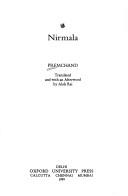
Nirmala
Premchand · 1880–1936 · India
Originally Nirmala (Hindi) · translated by Alok Rai
Why it matters
A bright teenager is married off to a widower twice her age after her family can't match a rival groom's dowry, then slowly suffocates under a household's suspicion. Premchand's fiercest attack on the dowry system, written to wound the practice, not just describe it.
At a glance
Plain realist prose; the weight lands in the story, not the style.
Deep dive
A dowry shortfall trades a fifteen-year-old to a man three times her age, and Premchand traces exactly how far the damage travels through a household that never meant any of it.
Written for readers who have finished the book. No plot recap, and nothing here is safe to read first.
Themes & symbolism
Nirmala's family loses her intended, younger, appropriate match when her father dies before the dowry can be paid, and the desperate solution, giving her instead to Totaram, a widower with grown sons and no expectation of a dowry at all, is presented by Premchand not as an aberration but as the dowry system working exactly as designed: a girl's worth gets renegotiated downward the moment her family's finances falter, regardless of her age or the age of the man she's traded to. Nirmala arrives in Totaram's household still essentially a child, closer in age to his eldest son Mansaram than to her husband, and that proximity is the seed of the novel's real catastrophe.
Totaram's growing, baseless suspicion that Nirmala and Mansaram share more than a stepmother's ordinary affection poisons the household from the inside, and rather than confront it directly he sends the boy away to a distant school, cutting off contact and, eventually, care, so that Mansaram falls ill away from home with nobody present to treat him in time. Premchand refuses to let any single villain carry the blame: Totaram's jealousy is itself a product of a marriage that never should have existed, and Nirmala's silence, forced onto her by a culture that gives a young wife no language to defend herself against her husband's suspicion, is what lets the misunderstanding fester unchallenged.
A Marriage Priced Down to What a Family Could Afford
Premchand is precise about the arithmetic: Nirmala's mother can't raise the dowry a suitable young groom's family expects, and Totaram's willingness to skip the dowry entirely is presented, without irony, as his most attractive quality to a desperate household, which is exactly the indictment. The novel keeps insisting that a match transacted on those terms was never going to be about the two people actually living inside it.
Silence as the Novel's Real Antagonist
Nirmala never tells Totaram what she actually feels for Mansaram, which is nothing beyond a stepmother's ordinary concern, because the social role available to a young wife gives her no standing to argue with her husband's suspicion, and Premchand builds the tragedy almost entirely out of that enforced muteness, a household destroyed less by any actual transgression than by a wife structurally unable to correct a misunderstanding threatening everyone she loves.
The last seal: what actually happens, and why it lands the way it does.
The ending, explained
Mansaram dies at his distant school of an illness that goes untreated because his estranged father has cut off contact, and the loss breaks something in Totaram that his jealousy never touched: he begins to suspect, too late, that his own suspicion manufactured the tragedy rather than prevented one. Nirmala, who has spent the marriage absorbing blame she never earned, is left to raise Totaram's younger children in a household now defined by a grief nobody can openly discuss, since naming its cause would mean admitting the marriage's entire foundation was rotten from the start. Premchand closes without granting Nirmala any exit or vindication, only the continued, unrewarded endurance the dowry system asked of her in the first place.
Where to go next
 Premchand · 1931GabanLvl 3Fast paced
 Premchand · 1936GodanLvl 3Medium pace
 Mahasweta Devi · 1974Mother of 1084Lvl 5Medium pace
 Ismat Chughtai · 1942The Quilt and Other StoriesLvl 4Fast paced