
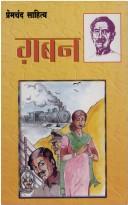
Gaban
Premchand · 1880–1936 · India
Originally Gaban (Hindi) · translated by Christopher R. King
Why it matters
A charming, weak-willed clerk feeds his wife's craving for jewelry into embezzlement, then a spiraling cover-up of debt and blackmail. Premchand turns his rural conscience on the aspirational Hindu middle class and finds it just as compromised.
At a glance
Straightforward chronological realism, easy to follow despite its darkening plot.
Deep dive
A small government clerk embezzles from his own office to buy his wife the jewelry she's set her heart on, and how much further both of them have to fall, separately, before either learns what the theft actually cost.
Written for readers who have finished the book. No plot recap, and nothing here is safe to read first.
Themes & symbolism
Ramanath's embezzlement isn't staged as a single moment of moral collapse so much as the endpoint of pressures Premchand takes pains to make sympathetic before he makes them damning: a clerk's low colonial-era salary, a wife, Jalpa, whose desire for fine jewelry is less personal vanity than an entirely reasonable wish to not be humiliated in front of wealthier relatives, and a culture of consumer display, imported ornaments, foreign fashions, that the colonial economy actively cultivates in people it has no intention of paying enough to satisfy honestly.
Once the theft is discovered, Ramanath doesn't face it, he flees, taking on a false identity and drifting into the company of petty criminals in Calcutta, and Premchand uses his disappearance to let Jalpa's half of the novel become the more interesting one: left to face the consequences of a crime she unwittingly provoked, she has to reckon with her own complicity without the luxury of running from it, and grows from an anxious, appearance-conscious young wife into someone willing to sell her own jewelry and put herself at real risk to try to set things right.
Premchand keeps Ramanath's crimes and Jalpa's growth on entirely separate tracks for most of the novel's middle stretch, refusing the reader the relief of a shared scene where husband and wife might simply talk their way out of the mess a single piece of jewelry started, and that separation is deliberate: the novel needs both halves of the marriage to fail and rebuild on their own terms before it can argue that the household's eventual repair means anything more than a plot resolving itself.
Jalpa's Reform as the Novel's Real Plot
Jalpa's arc, from a wife whose wounded pride over a bracelet sets the whole plot in motion to a woman who takes up the independence movement's cloth-boycotting activism and risks her own safety trying to undo the damage her earlier vanity caused, gives Gaban a moral trajectory that runs in the opposite direction from Ramanath's: where his crime sends him further from home and further into deception, her guilt sends her further into public, principled action.
Embezzlement as a Colonial Economy's Product
Premchand frames Ramanath's theft less as an individual moral failure than as the predictable output of a system that manufactures desire for imported luxury goods in people whose wages were set by the same colonial administration selling them, and the novel's reformist charge lands as much on that economic arrangement as it does on the young couple caught inside it.
The last seal: what actually happens, and why it lands the way it does.
The ending, explained
Ramanath's flight eventually brings him into contact with the same currents of nationalist activity that have absorbed Jalpa in his absence, and the two arcs converge: Jalpa's public courage and her willingness to risk everything to make amends for a debt that was never really hers to repay give Ramanath a model of integrity he couldn't find on his own, and the novel moves him back toward honesty and toward her rather than deeper into the underworld he fell into. Premchand resolves the plot's criminal mechanics more gently than its social critique, letting the couple's reunion stand for a broader argument, that individual moral repair and national self-reform are the same project, personal reconciliation as the small-scale version of the swaraj Premchand wanted for the country.
Where to go next
 Premchand · 1927NirmalaLvl 3Medium pace
 Premchand · 1936GodanLvl 3Medium pace
 Mahasweta Devi · 1974Mother of 1084Lvl 5Medium pace
 Ismat Chughtai · 1942The Quilt and Other StoriesLvl 4Fast paced