
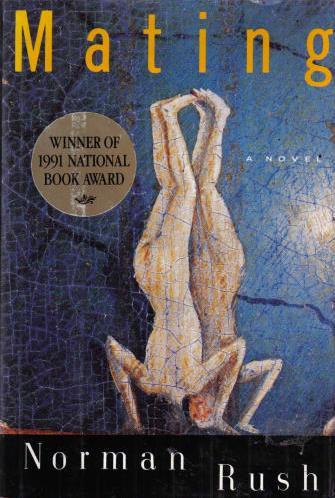
Mating
Norman Rush · b. 1933 · United States
Why it matters
An unnamed, formidably intelligent American anthropologist narrates her courtship of a charismatic visionary building a utopian, women-run development community in the Kalahari. Rush's National Book Award winner makes courtship and utopian politics equally demanding, equally seductive subjects.
At a glance
Dense, allusive, argument-driven prose and a narrator's restless intelligence ask for sustained concentration.
Deep dive
A courtship narrated by a woman so relentlessly self-aware that falling in love becomes, in her own telling, just another argument she's determined to win honestly.
Written for readers who have finished the book. No plot recap, and nothing here is safe to read first.
Themes & symbolism
The unnamed narrator's voice — hyper-articulate, constantly auditing her own motives even while she's falling for Nelson Denoon — is the novel's real achievement. Rush makes courtship a matter of competing intelligence and rhetoric as much as desire, staging their relationship as an extended argument about development economics, feminism, and utopian theory that is simultaneously, inseparably, a seduction. Her three-day solo trek across the Kalahari to reach Denoon's settlement is both a literal ordeal and something like a dowry paid in advance — proof of will offered before he's offered her anything back, which tells you exactly how the power in this relationship is going to be negotiated from the start.
Tsau, Denoon's experimental matriarchal development project for destitute women, embodies the novel's ambivalence about utopian social engineering: it is genuinely, materially better for the women living there than what came before, and it is also unmistakably his creation, dependent on his outside funding, charisma, and authority in ways that quietly contradict its own feminist premises. The narrator is sharp enough to see that contradiction clearly and chooses to set it aside for as long as the relationship holds — a compromise the novel neither condemns nor lets her off the hook for.
Grace Denoon, Nelson's estranged wife, functions as a warning the narrator registers and then walks past anyway — proof that Denoon's charisma has consumed and discarded an intelligent, capable woman before, and that the pattern is likely to repeat rather than resolve just because the current partner is smarter or more clear-eyed about it. The narrator's awareness of this precedent, stated openly rather than hidden from the reader, is part of what keeps the novel from reading as naive romance even at its most infatuated: she walks into the relationship with her eyes fully open to how it has ended before.
A Feminist Utopia Narrated by a Skeptic
Rush's narrator embraces feminist theory and distrusts easy rhetoric in the same breath, refusing to become a simple mouthpiece for either Denoon's project or a tidy political position of her own. That intelligence is both her defense against being swept away and the thing that makes total surrender to the love story impossible for her — she can't stop narrating, qualifying, and second-guessing even her own desire. It's a striking choice for a male novelist to channel a critique of utopian social engineering through so specific and skeptical a female instrument, and it's a large part of why the novel reads as genuinely inhabited rather than ventriloquized.
The last seal: what actually happens, and why it lands the way it does.
The ending, explained
Tsau collapses under a mix of internal politics, resource crises, and Denoon's own diminishing authority after a crisis in the bush that leaves him changed, less legible even to the narrator who has studied him so closely. She returns to the United States, and the novel closes on a distant, uncertain epilogue from Palo Alto — a cryptic message from Africa raising, without resolving, the question of whether she'll go back. The ending keeps the central romance exactly where the narrator's own voice has held it from the start: argued over, examined from every angle, and never quite settled.
Where to go next
 Karl Gjellerup · 1906The Pilgrim KamanitaLvl 5Slow burn
 Richard Powers · 2018The OverstoryLvl 7Slow burn
 Walker Percy · 1961The MoviegoerLvl 5Slow burn
 Oscar Hijuelos · 1989The Mambo Kings Play Songs of LoveLvl 5Medium pace
 Paul Harding · 2009TinkersLvl 6Slow burn
 Alison Lurie · 1984Foreign AffairsLvl 3Medium pace