
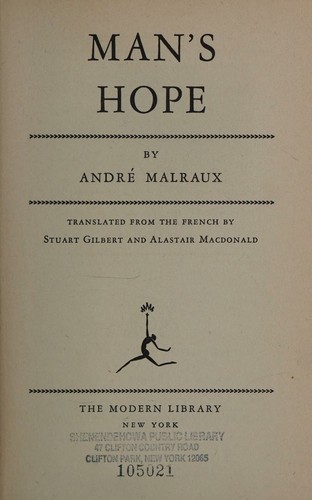
Man's Hope
André Malraux · 1901–1976 · France
Originally L'Espoir (French)
Why it matters
Republican pilots, peasants, and intellectuals improvise a defense of Madrid in the opening months of the Spanish Civil War. Malraux's sprawling, urgent novel of political action, written from his own time flying for the Republic.
At a glance
A large cast and fragmented battlefield chronology across a sprawling canvas.
Deep dive
Malraux puts his own international air squadron on the page under a different name and asks whether revolutionary hope can survive the machinery it takes to actually win a war.
Written for readers who have finished the book. No plot recap, and nothing here is safe to read first.
Themes & symbolism
L'Espoir opens in the chaotic first days after the July 1936 military uprising, with a Madrid telephone exchange and a handful of improvised militias standing between the Republic and collapse, and Malraux follows Manuel, a sound engineer with no military background who is handed command almost by default, as the war forces him from egalitarian militia leadership into the kind of hard discipline that wins battles but costs him the comradely intimacy the early defense ran on.
Magnin commands the international air squadron built almost entirely out of foreign volunteers and mercenary pilots of wildly uneven skill and commitment, and Malraux stages its early missions as chaos barely organized into effectiveness, planes that shouldn't fly, pilots who signed on for money rather than conviction, a squadron that has to become an actual military instrument before it can be any use to the cause that assembled it.
The novel's real argument runs through the gap between what Malraux calls the lyrical illusion, the first days' spontaneous, egalitarian solidarity, and the organization that has to replace it if the Republic is going to survive past those first days: Manuel's transformation into a commander capable of ordering executions and enforcing discipline his old comrades find unrecognizable is presented not as betrayal but as the price revolutionary hope has to pay to become an army rather than a gesture.
Malraux Flew the Missions He Wrote
Malraux organized and nominally commanded the España squadron of the same name in 1936, recruiting foreign pilots, buying aircraft partly with money raised on an American lecture tour, and flying combat and reconnaissance missions himself despite minimal formal training as a pilot. He published L'Espoir in December 1937 while the war was still being fought, close enough to events that Manuel and Magnin read less as invented characters than as versions of men Malraux had actually commanded, and the book's battle sequences carry a reportorial precision, unit names, tactics, terrain, that fiction written after the fact rarely bothers with. Malraux then filmed a segment of his own novel, Sierra de Teruel, shooting in Spain through late 1938 until the Republic's collapse forced the production to finish across the border in France; the film wasn't released until 1945, by which point the war it depicted had already been lost.
The last seal: what actually happens, and why it lands the way it does.
The ending, explained
The novel closes on the Battle of Guadalajara in March 1937, where Republican forces rout the Italian expeditionary corps Mussolini sent to support Franco, one of the war's few clear and largely unambiguous Republican victories. Malraux's final image is not the battle itself but its aftermath: peasants from the surrounding villages carrying wounded airmen down from a mountain crash site on improvised stretchers, ordinary solidarity outlasting the machinery of the war that the book has spent its length insisting revolutionary hope has to build in order to survive. Malraux ends there, on organization finally paying off in a real victory, before history could supply the defeat still two years off when he was writing.
Where to go next
 André Malraux · 1933Man's FateLvl 6Medium pace
 Simone de Beauvoir · 1954The MandarinsLvl 6Slow burn
 Louis-Ferdinand Céline · 1932Journey to the End of the NightLvl 6Fast paced
 Roger Martin du Gard · 1940The ThibaultsLvl 6Slow burn
 Claude Simon · 1960The Flanders RoadLvl 9Slow burn
 David Diop · 2018At Night All Blood Is BlackLvl 5Fast paced