
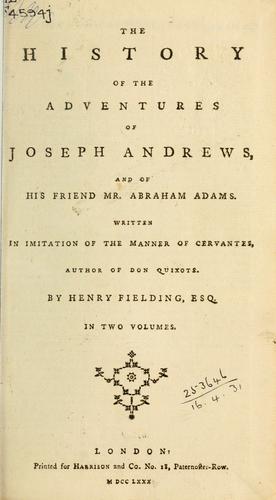
Joseph Andrews
Henry Fielding · 1707–1754 · England
Why it matters
Begun as a parody of Richardson's Pamela and grown into something larger, this comic road novel follows a virtuous footman and a good-hearted parson across England's highways, Fielding finding his own voice by mocking someone else's.
At a glance
Brisk mock-epic comedy, plainer and shorter than Fielding's later work.
Deep dive
Fielding sets out to mock a wildly popular novel about a virtuous servant girl by giving her brother the same ordeal in reverse, and then can't stop the joke from growing into something bigger than the target.
Written for readers who have finished the book. No plot recap, and nothing here is safe to read first.
Themes & symbolism
Fielding began the novel explicitly as a parody of Samuel Richardson's wildly popular Pamela, in which a servant girl's persistent virtue against her master's advances is eventually rewarded with marriage into his class, and Fielding's opening joke is structural: Joseph Andrews is Pamela's brother, footman to Lady Booby, and finds himself fending off his own employer's advances in almost exactly the same terms Pamela used to fend off Mr. B, right down to protesting his virtue in language that reads as absurd coming from a young man rather than a young woman. The gender reversal exposes, more effectively than direct argument could, how much of Pamela's celebrated virtue was really about the marketability of female chastity rather than any general moral principle Richardson claimed to be defending.
Parson Adams, the genuinely good, comically impractical clergyman who accompanies Joseph on the road, becomes the novel's real center of gravity well before the Pamela parody has run its course, and Fielding uses Adams's total obliviousness to social hierarchy and self-interest, he'll fight for a stranger's honor as readily as for a friend's and never once calculates what it costs him, as the positive moral standard the surrounding cast of vain innkeepers, corrupt magistrates, and self-serving clergymen keep failing to meet. The novel widens from a targeted joke about one bestseller into a broader picaresque satire of English social hypocrisy precisely because Adams, unlike Joseph, was never conceived as a parody of anyone; he's Fielding's own invention, and the book gets more interesting exactly when it stops needing Richardson's plot to react against.
The Foundling Plot Fielding Almost Didn't Need
Fielding resolves Joseph and Fanny's marriage obstacle with one of the eighteenth-century novel's most reliable devices, a set of birthmarks and a peddler's testimony revealing that neither is who the household assumed, but he stages the revelation with enough comic excess, false starts, contradictory claims, a scene that nearly reveals the wrong relationship entirely, that the convention reads as much mocked as used. It's consistent with Fielding's whole method in the novel: rather than simply avoiding the sentimental machinery Richardson and later novelists relied on, he keeps the machinery running while making its gears visible, letting readers enjoy the plot's neat resolution and its absurdity in the same breath.
The last seal: what actually happens, and why it lands the way it does.
The ending, explained
The peddler's late testimony untangles the plot's central obstacle: Fanny and Joseph, who had spent much of the novel's final stretch fearing they were secretly brother and sister after a story surfaces about swapped or stolen infants, turn out to be unrelated, while Joseph is revealed as the actual long-lost son of the gentleman Mr. Wilson, restoring him to a social position that conveniently, if a little too neatly, removes the class obstacle to his marrying Fanny at all. Lady Booby, whose pursuit of Joseph launched the whole plot, is left to retreat from the county in humiliation once the marriage goes ahead, her desire never punished by the law or the church, just by comic irrelevance, which is exactly the tone Fielding sustains throughout: not moral severity but persistent, good-humored deflation of anyone who mistakes rank or desire for entitlement.
Where to go next
 Henry Fielding · 1749Tom JonesLvl 5Fast paced
 Jonathan Swift · 1726Gulliver's TravelsLvl 5Medium pace
 William Makepeace Thackeray · 1848Vanity FairLvl 5Medium pace
 Miguel de Cervantes · 1605Don QuixoteLvl 6Medium pace
 Laurence Sterne · 1759The Life and Opinions of Tristram Shandy, GentlemanLvl 9Slow burn
 Voltaire · 1759CandideLvl 3Fast paced