
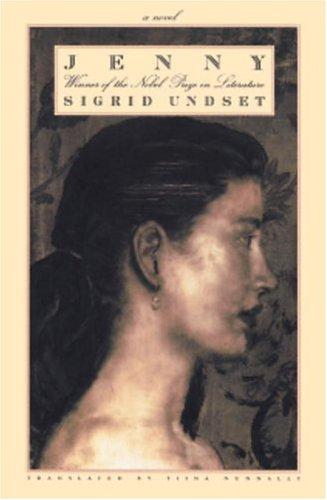
Jenny
Sigrid Undset · 1882–1949 · Norway
Originally Jenny (Norwegian)
Why it matters
Before the Middle Ages claimed her, Undset's breakthrough novel followed a young Norwegian painter in Rome undone by love, ambition, and an unwanted pregnancy. Its frank treatment of a woman's sexual and creative frustration scandalized genteel Norway on publication.
At a glance
A more straightforward contemporary narrative than her medieval epics.
Deep dive
Why Undset, a decade before her Catholic conversion, gives a gifted young painter no framework at all for surviving the same kind of shame Kristin Lavransdatter's church would eventually let its heroine work through.
Written for readers who have finished the book. No plot recap, and nothing here is safe to read first.
Themes & symbolism
Jenny Winge is a serious, talented Norwegian painter living independently in Rome, and Undset establishes her ambition and artistic seriousness before the novel's romantic plot ever begins, so her later collapse reads not as a woman undone by love in the conventional sense but as a specific, modern crisis: a woman who wanted both freedom and connection discovering that 1911 Norway, for all its stated progressiveness, has built her no actual path to both at once.
Jenny's engagement to the passive, indecisive Helge Gram stalls under his own inability to commit, and in a moment of despair and self-punishment she sleeps instead with his father, Gert Gram, an older man from her own artistic circle, an act Undset frames less as desire than as a kind of furious self-sabotage, proof to herself that she is exactly as unworthy of stable happiness as her own spiraling doubt has already convinced her she is.
Rome itself gives Jenny an early, genuine freedom the novel is careful not to undercut retroactively: she paints seriously, keeps her own studio, and moves through an international circle of artists on equal footing with the men around her, which is exactly why her later unraveling reads as a specific betrayal of what that freedom seemed to promise rather than proof it was illusory from the start. Undset's sympathy stays with Jenny's ambition even as the plot dismantles the life built around it.
A Novel Without a Church to Fall Back On
Written a full decade before Undset's conversion to Catholicism would give Kristin Lavransdatter's heroine an entire theology of guilt and eventual grace to work through her own transgression, Jenny offers its heroine no such structure: shame here has nowhere to go, no confession, no penance, no promise of eventual mercy, only a modern secular vocabulary of self-disgust that Undset renders as genuinely inescapable. That absence is precisely why the novel scandalized a Norwegian public more comfortable with a fallen woman's shame ending in marriage or death than in this kind of total, undramatic despair.
The last seal: what actually happens, and why it lands the way it does.
The ending, explained
The child born of the affair with Gert Gram dies in infancy, removing the one outcome that might have given Jenny's disgrace some forward-facing purpose, and Undset lets her heroine's isolation deepen from there rather than resolve: Helge's own belated jealousy and reproach arrive only once it is far too late to matter, her friendships thin out under a shame she cannot fully explain to anyone still willing to listen, and Jenny, convinced that neither her art nor her private life amount to anything she can still respect, takes her own life alone in her Christiania flat. Undset offers no framing verdict on the act, no narrator stepping in to call it sin or tragedy or waste, which is exactly the absence Jenny herself has spent the whole novel unable to fill with anything else.
Where to go next
 Sigrid Undset · 1909Gunnar's DaughterLvl 4Fast paced
 Sigrid Undset · 1920Kristin LavransdatterLvl 6Slow burn
 Sigrid Undset · 1925The Master of HestvikenLvl 6Slow burn
 Knut Hamsun · 1890HungerLvl 5Medium pace
 Frans Eemil Sillanpää · 1931The Maid SiljaLvl 4Medium pace
 Johannes V. Jensen · 1922The Long JourneyLvl 6Medium pace