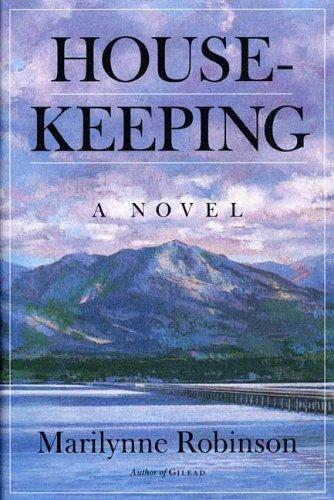
Housekeeping
Marilynne Robinson · b. 1943 · United States
Why it matters
Two orphaned sisters are raised by a drifter aunt in a remote Idaho town beside a lake that has swallowed their family. Robinson's debut, a spare and haunting meditation on transience and belonging.
At a glance
Dense, image-heavy lyrical prose moves obliquely rather than through plot.
Deep dive
Why Ruth finally chooses her aunt Sylvie's way of living over her sister's, and what it means that the family's lake has already claimed three of the dead before the novel even begins.
Written for readers who have finished the book. No plot recap, and nothing here is safe to read first.
Themes & symbolism
The lake below Fingerbone already holds Ruth and Lucille's grandfather, thrown from a train that slid off the bridge into the water one winter night before either girl was born, and their mother Helen, who parked a borrowed car on a bluff above the same lake and walked into it. Robinson doesn't treat the water as symbol so much as inheritance: a geography that has already demonstrated, twice, what it does with the family's unhappiness, and the girls grow up on a hillside built the way it is because the lake floods the town on a schedule everyone has stopped remarking on.
When their grandmother dies and two great-aunts, Lily and Nona, fail the job within a winter, the girls' itinerant aunt Sylvie arrives to keep house, and keeps it by every wrong measure available: she sleeps in her coat, eats standing at the sink in the dark, lets leaves and a family of swallows drift in through propped doors, stacks tin cans and old newspapers against a flood that hasn't come yet. Robinson refuses to read this as neglect. Sylvie's housekeeping is a rival discipline, a refusal to hold the line between inside and outside that a house is normally built to hold, and the longer she stays the more that refusal starts to look like the only honest response to a family this thoroughly acquainted with loss.
Lucille's Kitchen and the Argument Over What Counts as Normal
Lucille and Ruth are raised side by side and diverge almost precisely down the middle: Lucille starts sewing her own clothes from a pattern book, joins home economics, courts a boyfriend, and moves in with her schoolteacher rather than keep living the way Sylvie lives. Robinson gives Lucille's choice its full weight rather than treating it as betrayal, a hunger for ordinariness that is no less real, or less understandable, than Ruth's drift in the opposite direction. Robinson keeps the sisters' final estrangement almost wordless. There is no argument that severs them, only two increasingly separate ideas of what a house is for, worked out in the same kitchen until one sister simply stops coming home to it.
The last seal: what actually happens, and why it lands the way it does.
The ending, explained
After a well-meaning sheriff moves to separate Ruth from Sylvie's custody, the two of them respond by burning the house down and crossing the railroad trestle over the lake on foot at night, the same bridge that took their grandfather, walking out of Fingerbone rather than submit to being kept apart. The town concludes they drowned. Ruth's narration, it becomes clear only gradually, comes from years afterward, a life of drifting town to town with Sylvie that never resolves into a fixed address, and the book's last pages imagine, without confirming, a visit to Lucille's lit window that Lucille never quite notices, transience and permanence left sitting, unresolved, on opposite sides of the same glass.