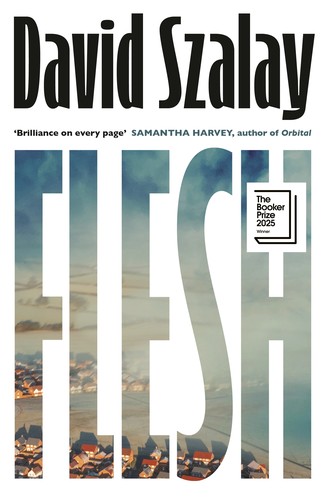
Flesh
David Szalay · b. 1974 · England
Why it matters
Taciturn Hungarian István drifts from an impoverished childhood through military service, prison, and an improbable rise into London's moneyed elite, entire years vanishing between paragraphs. Szalay's terse, gapped 2025 Booker Prize winner turns one unexamined life into something close to tragedy.
At a glance
Terse, elliptical prose deliberately omits connective tissue, leaving readers to infer what happened between scenes.
Deep dive
What to expect from a Booker winner about one man's entire life, when the novel refuses to narrate most of it.
Written for readers who have finished the book. No plot recap, and nothing here is safe to read first.
Themes & symbolism
Szalay made his reputation with the Booker-shortlisted All That Man Is by cutting between nine different men's lives with chapters that skip years without transition and dialogue stripped of interiority — prose that reports what a man did and almost never what he felt. Flesh applies that same withholding method to a single continuous protagonist across a whole life rather than to a cross-section of different men, and the bet is structural: that the unnarrated gaps between an impoverished childhood, military service, prison, and an improbable rise into London's moneyed elite will register as loss more powerfully than any scene of loss Szalay could write directly.
István's taciturnity is characterization by withdrawal rather than absence: a protagonist who says little and explains less forces the reader to infer his interior life entirely from action and consequence, an approach that risks reading as coldness but that Szalay has used before to build sympathy obliquely — the less a character explains himself, the more his silences read as scar tissue rather than blankness. Class mobility in the novel functions less as triumph than as another kind of vanishing: each rung he climbs carries István further from whatever originally shaped him, so that arrival among the moneyed elite reads less like victory than like the most complete erasure of self the book has staged yet.
The Grammar of the Gap
The white space between sections is doing the work exposition usually does — years pass in a blank line, and the reader is left to reconstruct what filled them from whatever the next scene lets slip. It's the same wager Szalay made at shorter range in All That Man Is: that a life rendered mostly in ellipsis, with the connective tissue of ordinary causation withheld, can feel more truthful than a fully narrated one, because most lives are experienced that way too, in retrospect — a handful of vivid rooms with the years between them already gone quietly dark.