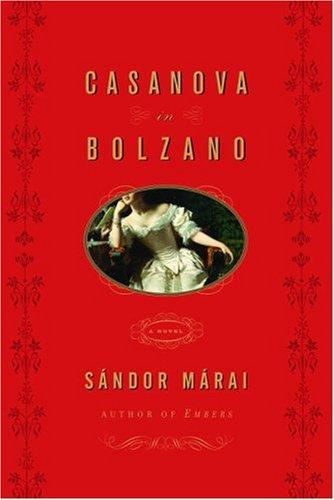
Casanova in Bolzano
Sándor Márai · 1900–1989 · Hungary
Originally Vendégjáték Bolzanóban (Hungarian)
Why it matters
Fresh from his escape out of Venice's prisons, Casanova stops in Bolzano and is drawn into a three-day duel of wit and vanity with the aging Duke who shares his lost love. Márai turns the legendary seducer into a philosopher of pride's expiration date.
At a glance
A dialogue-driven chamber drama in Márai's familiar register, less demanding than his interior monologues.
Deep dive
Fresh from his real-life escape out of a Venetian prison, Casanova stops in a small Alpine town, where an aging duke he once humiliated proposes a wager involving the one woman both men have never stopped thinking about.
Written for readers who have finished the book. No plot recap, and nothing here is safe to read first.
Themes & symbolism
Márai picks up the historical Casanova immediately after his celebrated 1756 escape from the Leads, the prison beneath the Doge's Palace, and strands him in Bolzano, where years earlier, as a young man, he had been the lover of Francesca, now married to the aging Duke of Parma. Rather than banish his old rival, the Duke summons Casanova for a long night of conversation that Márai stages almost entirely as dialogue, a debate about age, desire, and mastery dressed as hospitality, in which the Duke ultimately proposes a wager: a fortune, in exchange for a single night with Francesca, after which Casanova must leave Bolzano and never return.
The wager treats Francesca throughout as the stake in a contest between two men rather than a participant in her own right, and Márai is deliberate about that erasure: it is only in the novel's final private scene between Casanova and Francesca herself that she is finally allowed to want something neither man has planned for, undercutting both the Duke's cynical arrangement and Casanova's practiced seduction with a desire that belongs, briefly, entirely to her. Márai gives the Duke's own account of aging its full weight rather than treating him as merely an obstacle: his long speeches on watching desire outlast the body's capacity for it are as carefully argued as anything Casanova says in his own defense, so that the novel reads less like a contest between a young man and an old one than between two different theories of what a life spent wanting things is actually for.
A Seduction Written as a Duel
Márai structures the Duke's proposal explicitly as a wager rather than a request, complete with stakes, terms, and a deadline, turning what could have been a simple love triangle into something closer to a duel of honor fought entirely through negotiation rather than swords. The choice reflects the same interest that drives Embers, two men relitigating an old betrayal across a table decades after the fact, except here the third party at the center of the dispute finally gets to speak for herself before the night is over. The novel's long central dialogue, conducted almost entirely in the Duke's private study while Casanova waits out the hours until midnight, borrows its patience from stage drama rather than fiction, unfolding in something close to real time.
The last seal: what actually happens, and why it lands the way it does.
The ending, explained
Casanova wins the wager and spends the agreed night with Francesca, then leaves Bolzano at dawn exactly as the terms demanded, but Márai denies him anything like triumph: the whole arrangement, staged and negotiated as a contest between the two men, reads by morning as one more instance of a man who conquers precisely because he never stays long enough to be truly known. Francesca, far from simply having been won, turns out to have arranged the final terms of her own farewell to him, sending Casanova away with a clarity that leaves her, not him, the only person in the novel who ends the night having actually decided something.