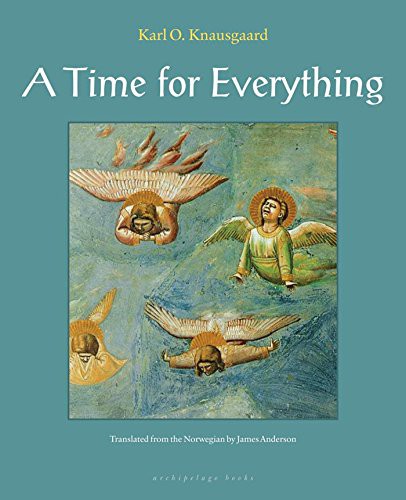
A Time for Everything
Karl Ove Knausgaard · b. 1968 · Norway
Originally En tid for alt (Norwegian) · translated by James Anderson
Why it matters
A Renaissance scholar's obsessive study of biblical angel sightings, from Eden to Ezekiel, becomes a strange, sweeping meditation on the divine made visible in the world, before My Struggle turned the lens on himself.
At a glance
Dense theological digression braided through retold biblical narratives.
Deep dive
What it means that angels get stranger and more damaged every time they turn up in this retelling of Genesis and Ezekiel, right up until one of them can no longer fly at all.
Written for readers who have finished the book. No plot recap, and nothing here is safe to read first.
Themes & symbolism
Knausgaard retells a handful of familiar Old Testament episodes, Cain and Abel, Noah's flood, Lot's flight from Sodom, Ezekiel's vision by the river Chebar, and in each one gives the angels a body that gets stranger and more damaged with each appearance, from luminous, faintly terrifying visitors at Cain's fire to the multi-eyed, wheel-riding horror of Ezekiel's account. The sequence reads as a slow historical record of the sacred losing its composure, as if divinity itself were degrading the longer human beings kept trying to look directly at it. The flood chapter, in particular, turns Noah into a reluctant participant rather than a chosen hero, unable to meet the eyes of drowning neighbors as the water rises, a discomfort Knausgaard treats as more theologically serious than the rescue itself.
The book frames these retellings with the fictional scholarship of Antinous Bellori, a sixteenth-century Italian who writes an entire treatise attempting to classify and explain angelic biology in something like scientific terms, an Enlightenment impulse arriving centuries early and finding, as it always does here, that measurement kills exactly what it sets out to understand. Bellori's dry, taxonomic voice framing genuinely uncanny events is Knausgaard's clearest joke and his most serious argument at once: reason and revelation cannot occupy a sentence together without one of them losing. Bellori's own biography, ending in obscurity rather than vindication, previews the fate awaiting anyone who tries to pin the sacred down with a ruler rather than simply witness it.
Cain's Shame as the Birth of an Inner Life
Knausgaard's Cain and Abel section lingers less on the killing than on what happens to Cain afterward, the first human being in the text to feel something like private, wordless guilt rather than simply react to circumstance. Knausgaard treats that shame, not the murder, as the real rupture in Genesis, the moment a person first has an interior separate from what he does in front of others, and reads the angel who marks Cain for protection as history's first acknowledgment that an inner life, once it exists, has to be answered for.
The last seal: what actually happens, and why it lands the way it does.
The ending, explained
The novel's closing section jumps forward to a nameless modern recluse who finds a wingless, dying angel and, rather than revering it, cages it, studies it, and eventually kills and dissects it to establish, empirically, that it existed at all. The scene mirrors Bellori's earlier taxonomic ambition taken to its most literal conclusion: offered an actual miracle, the contemporary response is autopsy rather than wonder, evidence over awe. Knausgaard closes the book with angels effectively gone from the world, not through disbelief but through having finally, fully explained, which the novel treats as the same thing. The frame's opening image, a boy on frozen ice glimpsing two lights nobody else believed he saw, reads by the end as the last sighting before the species stopped being able to see them at all.