
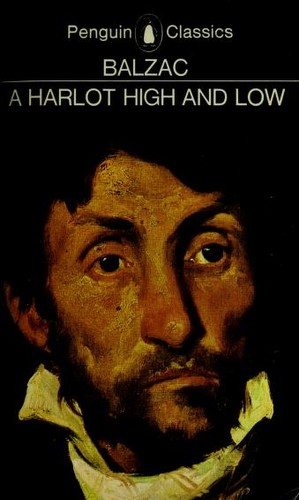
A Harlot High and Low
Honoré de Balzac · 1799–1850 · France
Originally Splendeurs et misères des courtisanes (French)
Why it matters
Lost Illusions' Lucien returns, entangled with a courtesan and a sinister cleric-confessor whose true influence over Lucien runs far deeper than either admits, as Balzac plunges into Parisian vice, police, and prisons at his most sprawling and sinister: the underworld sequel that outdoes the original's ambition.
At a glance
Sprawling cast, criminal argot, and dense plotting make it Balzac's longest, most demanding underworld novel.
Deep dive
Lucien de Rubempré gets his second chance at Paris exactly the way Lost Illusions promised, on the arm of a reformed courtesan and under the protection of a mysterious Spanish priest, and Balzac spends eight hundred pages proving that bargain was never actually a chance.
Written for readers who have finished the book. No plot recap, and nothing here is safe to read first.
Themes & symbolism
The novel opens essentially where Lost Illusions ends, with the Abbé Carlos Herrera, secretly Vautrin, the escaped master criminal, in disguise as Lucien's priestly protector and rescuer, now openly running him as an instrument in Parisian high society. What that earlier novel only implied, that total obedience was the actual price of Vautrin's patronage, becomes explicit and literal here almost immediately, the debt made visible rather than merely threatened.
Esther Gobseck, the courtesan Lucien loves and who has genuinely reformed for his sake, is kept hidden by Vautrin to protect Lucien's prospective marriage into the aristocratic Grandlieu family, and the novel's cruelest turn is Vautrin's decision to sell her, one final time, to the wealthy banker Nucingen to fund Lucien's continued rise, a degradation dressed up as practical necessity that Esther cannot survive with any part of herself intact.
Once a forged promissory note is traced back to Lucien and Vautrin, the novel plunges into Paris's actual police, prison, and judicial machinery with a procedural density unmatched anywhere else in Balzac's work, criminal argot, interrogation tactics, prison administration rendered in close, almost documentary detail that reads like an ancestor of later crime fiction rather than the drawing-room satire the Comédie humaine is usually known for.
The Grandlieu family's cold, purely genealogical vetting of Lucien as a prospective son-in-law, commissioning a private investigation into his background rather than judging him on anything he's actually done or said, exposes the aristocracy this novel keeps circling back to as no less transactional than Vautrin's underworld, just conducted with better manners and cleaner paperwork. Balzac is careful to make the Grandlieus' due diligence entirely reasonable on its own terms, which is precisely what makes the parallel to Vautrin's criminal bookkeeping land as an indictment rather than a coincidence.
Vautrin's Final, Cruelest Trade
Once Lucien is dead and Vautrin's own criminal identity is fully exposed to the authorities, he strikes a bargain that lets him escape prosecution by being appointed to head the very police division tasked with hunting men like himself, master criminal converted, almost seamlessly, into chief detective. It's Balzac's bleakest possible joke about which side of Restoration France's institutions ultimately absorbs the other, and Vautrin's survival, alone among everyone this novel destroys, is the punchline.
A Sequel Longer Than the Book It Continues
At roughly twice the length of Lost Illusions, this sequel doesn't simply extend Lucien's story, it dwarfs the novel that set it up, and Balzac structures that imbalance deliberately: the provincial ambition and literary failure of the first book get resolved in a handful of chapters here, almost as a formality, before the real subject, what Vautrin's patronage actually costs, takes over completely. A reader who found Lost Illusions merely tragic is meant to discover, on finishing this one, that the earlier book was comparatively merciful.
The last seal: what actually happens, and why it lands the way it does.
The ending, explained
Esther, told by Vautrin that one last night with Nucingen will secure the money needed to save Lucien, complies, then poisons herself rather than live with what the act cost her, leaving her fortune to Lucien regardless. The forged note is traced back to him, and under interrogation and the psychological pressure of imprisonment, Lucien hangs himself in his cell rather than face trial or implicate his protector, the bargain that closed Lost Illusions finally collectable in exactly this coin, a debt he thought he was merely deferring rather than already owing in full.
Where to go next
 Honoré de Balzac · 1831The Wild Ass's SkinLvl 5Fast paced
 Honoré de Balzac · 1832Colonel ChabertLvl 3Medium pace
 Honoré de Balzac · 1833Eugénie GrandetLvl 3Medium pace
 Honoré de Balzac · 1835Père GoriotLvl 4Medium pace
 Honoré de Balzac · 1837Lost IllusionsLvl 5Medium pace
 Honoré de Balzac · 1842The Black SheepLvl 5Medium pace