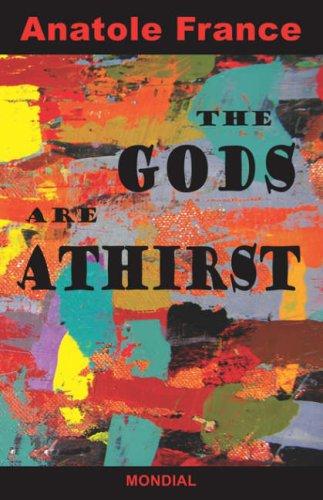
The Gods Are Athirst
Anatole France · 1844–1924 · France
Originally Les Dieux ont soif (French)
Why it matters
A gentle young painter turns fanatical juror during the Terror, sending former friends to the guillotine in the name of virtue. France's coolest, most devastating study of revolutionary zeal curdling into bloodlust.
At a glance
Clear narrative prose, though its sustained irony rewards attentive reading.
Deep dive
A gentle painter joins the Revolutionary Tribunal to help save the Republic he loves, and France builds an entire novel around how completely certain he remains of his own virtue with every name he sends to the guillotine.
Written for readers who have finished the book. No plot recap, and nothing here is safe to read first.
Themes & symbolism
Évariste Gamelin begins the novel as a poor, sincere young painter genuinely devoted to revolutionary ideals, and his appointment as a juror on the Revolutionary Tribunal during the Terror is framed not as corruption but as an intensification of the same idealism: Gamelin votes for execution after execution, including former friends and, eventually, people close to his own household, entirely convinced each verdict is a necessary sacrifice to virtue rather than a personal cruelty, since he has simply relocated his conscience into the Tribunal's collective judgment rather than abandoned it.
The title's image, gods that are perpetually athirst, casts the guillotine itself as a deity Gamelin's Paris has installed in place of the altars the Revolution tore down, demanding blood with the same appetite the old church once demanded devotion. France's real subject is the machinery by which a genuinely humane man convinces himself that feeding that appetite is mercy: Gamelin never once doubts his own goodness, which is precisely what lets him become, within a single year, someone his earlier self would have condemned without hesitation.
Gamelin's own former art teacher and a friend from his own poor, struggling years both eventually appear before his tribunal, and France stages his votes against them with the same procedural calm he brings to strangers, refusing the reader even the relief of watching him hesitate over people he has actually loved. That flatness, rather than any single dramatic breakdown, is the novel's most damning evidence that ideology has fully replaced personal loyalty as the organizing principle of his conscience.
A Warning Written in 1912
France published the novel more than a century after the Terror it depicts but with an unmistakable eye on his own moment, an era of mounting nationalist and revolutionary fervor across Europe that he watched with open alarm. Gamelin's total, unexamined certainty is less a period portrait than a general diagnosis, one that reads, in hindsight, as an anticipation of exactly the kind of ideological zealotry the twentieth century would go on to produce at a scale even France's bleak imagination had not yet pictured.
The last seal: what actually happens, and why it lands the way it does.
The ending, explained
Once Robespierre falls on 9 Thermidor, the same tribunal machinery Gamelin served turns without hesitation on its own former agents, and he is arrested, tried, and guillotined in his turn by a Paris that has already moved on to denouncing yesterday's zealots as today's monsters, with no more scrutiny of the charges than Gamelin himself ever gave the people he condemned. Élodie, his lover, mourns him only briefly before accepting the attentions of a new, carefully apolitical suitor within weeks, and France closes the novel on that fast, indifferent turnover, a city that consumed one wave of true believers and is already generating the appetite for the next, the gods of the title exactly as athirst as they were on the first page.