
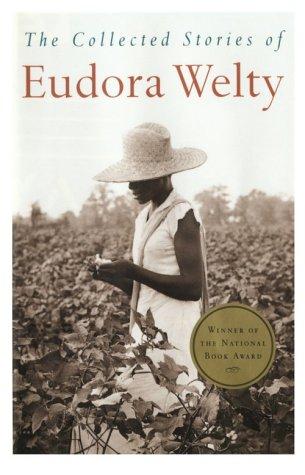
The Collected Stories of Eudora Welty
Eudora Welty · 1909–2001 · United States
Why it matters
Welty's complete short fiction gathers five decades of Mississippi lives told with wry, closely observed comedy that opens, again and again, onto grief and memory. It won the National Book Award in the paperback category in 1983.
At a glance
Individually accessible stories vary widely in tone and technique across five decades.
Deep dive
What holds five decades of Mississippi talkers together: a comic voice that keeps sliding, mid sentence, into grief nobody asked to hear.
Written for readers who have finished the book. No plot recap, and nothing here is safe to read first.
Themes & symbolism
Welty's stories keep circling back to a single technical trick: a first-person monologue that gives away far more than its speaker intends. Sister's furious, self-justifying account of walking out on her family in "Why I Live at the P.O." is a comic tour de force of small-town pettiness that also, without ever saying so, exposes a woman who has organized her whole life around being wronged. Leota's beauty-parlor patter in "Petrified Man" works the same way, gossip about a sideshow performer and a rapist on the loose spooling out in a Mississippi drawl that lets Welty smuggle real menace past a reader laughing at the surface.
"A Worn Path" runs the trick in the other direction: Phoenix Jackson, elderly and half-blind, walks miles into town for medicine for a grandson she describes in such fixed, ritual language that the story lets the reader wonder, and never confirms, whether the boy is even still alive to need it. Welty refuses the sentimental payoff a lesser writer would supply, the walk matters on its own terms, endurance as a kind of devotion that doesn't require an answer.
The collection reprints her books in their original order, and read straight through, that order shows a single method deepening: by "The Golden Apples," the connected Morgana stories, Welty has layered actual myth, a wandering seducer named King MacLain standing in for Zeus, women in his wake standing in for every mortal a god ever left pregnant and famous, underneath ordinary small-town frustration, so that "June Recital" and "Moon Lake" read as gossip and as epic at once.
Sister's Unreliable Grievance
Sister narrates "Why I Live at the P.O." as a wronged party defending herself to an invisible jury, but every fact she offers to prove her sister Stella-Rondo's cruelty doubles as evidence of her own controlling, score-keeping nature. Welty never editorializes; the comedy is entirely structural, built from a narrator so busy winning the argument that she can't see she's alone in the post office because she built it that way herself.
King MacLain's Long Shadow Over Morgana
The Golden Apples sequence's absent patriarch, glimpsed sideways for decades by the women and children he's left behind, gives the whole cycle its organizing myth: a man who gets to wander while everyone else stays fixed in Morgana, aging inside stories that keep circling back to him without his notice. Virgie Rainey's late reckoning with her mother's death and her own thwarted ambitions, in the volume's closing pages, plays as the cycle's answer to that absence, a woman finally choosing what King MacLain never had to.
Where to go next
 Eudora Welty · 1946Delta WeddingLvl 6Slow burn
 Eudora Welty · 1972The Optimist's DaughterLvl 4Medium pace
 William Faulkner · 1930As I Lay DyingLvl 9Medium pace
 Jesmyn Ward · 2017Sing, Unburied, SingLvl 5Medium pace
 Ellen Gilchrist · 1984Victory Over Japan: A Book of StoriesLvl 3Medium pace
 Cormac McCarthy · 1992All the Pretty HorsesLvl 6Medium pace