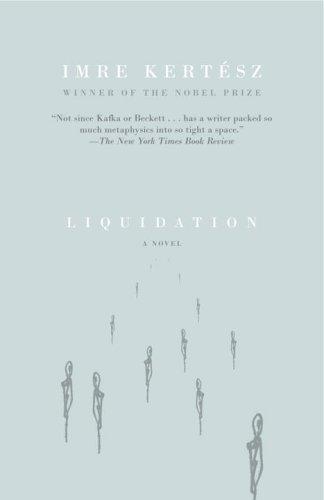
Liquidation
Imre Kertész · 1929–2016 · Hungary
Originally Felszámolás (Hungarian)
Why it matters
A Budapest editor hunts for the novel his late friend B., an Auschwitz survivor, seems to have written and destroyed before taking his own life: a manuscript that already knew how its author would end. Kertész's spare, self-devouring coda to Fatelessness.
At a glance
A metafictional search for a maybe-nonexistent manuscript, nested inside the very text searching for it.
Deep dive
A Budapest editor spends the novel hunting for a manuscript his dead friend B. may never have actually written, chasing a text that would already have known exactly how its own author's story was going to end.
Written for readers who have finished the book. No plot recap, and nothing here is safe to read first.
Themes & symbolism
Keserű, an editor at a Budapest publishing house being sold off in the scramble after 1989, searches through the papers of his late friend B., a writer born, unmistakably, inside Auschwitz itself, for a novel B. is rumored to have written and then destroyed before taking his own life. The one thing B. did leave behind, a short play also titled Liquidation and reproduced whole inside Kertész's novel, appears to have predicted his death with uncanny precision, collapsing any clean line between prophecy and self-fulfilling design: a writer capable of scripting his own ending this exactly raises the unanswerable question of whether he simply carried out the plan his own fiction had already written for him.
The title carries its full weight in two directions at once, the economic liquidation of a state publishing house being dissolved and sold as Communism gives way to a market economy, and the personal liquidation of a life that Kertész refuses to treat as a separate, unrelated event. Post-1989 Hungary offers no redemptive alternative to the decades that preceded it in this novel, only a different bureaucratic machine performing its own version of dissolving people and institutions whose function has quietly expired.
Kertész published Liquidation at seventy-four, barely more than a hundred pages against Fatelessness's much longer canvas, and the spareness reads as a formal decision as deliberate as anything in the plot: closing out an autobiographical project by making the final book physically thinner, more elliptical, more reluctant to explain itself. B.'s single surviving play does more work standing alone, unexplained and largely unglossed inside Keserű's narration, than a fuller manuscript could have, since its brevity forces the reader into the same interpretive position Keserű occupies, holding a small, finished object and having to decide for himself how much of a life it can actually account for.
A Search That Was Never Really About Finding Anything
Kertész gives readers B.'s embedded play in full, but the larger, rumored novel Keserű is actually hunting for stays permanently unconfirmed, possibly destroyed, possibly never written at all, and the search's real point isn't recovery but the compulsion to keep looking as a way of certifying that a friend's death, and by extension a life, meant something legible. The less findable the manuscript becomes, the more clearly the novel argues that some searches are only ever proxies for grief that has nowhere else to go.
The last seal: what actually happens, and why it lands the way it does.
The ending, explained
Keserű's investigation turns up B.'s former partner, Judit, who holds what papers remain, and the search closes without ever producing the larger novel rumored to exist. Keserű ultimately accepts that the play is the whole of what B. left behind, that no more complete text is waiting to be recovered, and that a work which had already scripted its author's death made any further, ordinary sense of completion beside the point from the start. Kertész denies the search a discovery, offering instead the harder recognition that some deaths, and the texts written to explain them, simply refuse to resolve into anything more legible than themselves.