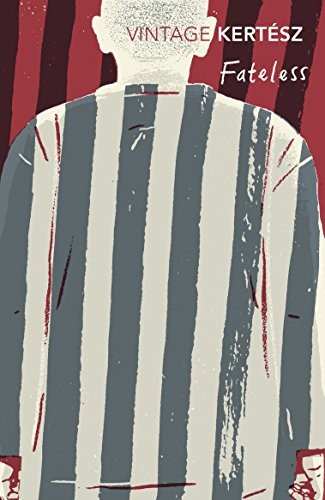
Fatelessness
Imre Kertész · 1929–2016 · Hungary
Originally Sorstalanság (Hungarian)
Why it matters
A fourteen-year-old narrates Auschwitz and Buchenwald finding even there a routine, a rhythm, moments of something like happiness. Kertész's Nobel-winning testimony that refuses every consolation, including our word 'unimaginable.'
At a glance
A deliberately flat, ironic adolescent voice narrating atrocity resists easy emotional reading.
Deep dive
A fourteen-year-old narrates the camps in the same flat, curious register he'd use for any unfamiliar new experience, and the novel's real target isn't the Nazis but our need to call any of it a coherent story.
Written for readers who have finished the book. No plot recap, and nothing here is safe to read first.
Themes & symbolism
Gyuri's flat, almost bureaucratic narration — noticing a decent bowl of soup, an SS officer's grudging approval, the strange camaraderie of fellow prisoners with the same attentive neutrality he'd bring to any new place — is not a failure of feeling but the novel's entire ethical position. Kertész refuses the adult survivor-narrator's retrospective horror because his fourteen-year-old self genuinely doesn't have it yet, and that refusal forces the reader past the comforting idea of the Holocaust as simply 'unimaginable' into the far more disturbing truth that human beings adapt, moment to moment, to even the most monstrous circumstances by way of perfectly ordinary psychological processes.
The title names the book's real argument: 'fate' is a shape — meaning, arc, lesson — that gets imposed after the fact by systems that need the Holocaust to be comprehensible, whether that's religious tradition, existentialist philosophy, or a national memory culture demanding redemptive testimony. Kertész insists that at the moment of living through it, experience has no such shape, only an undifferentiated sequence of steps each of which felt to Gyuri like simply the next thing to be gotten through — and that retrofitting a moral arc onto that sequence, however consoling, is itself a falsification of what actually happened.
Kertész, himself a survivor of Auschwitz and Buchenwald deported at fourteen, spent over a decade writing and revising the novel, and its Hungarian publication met years of official indifference before international translation and the 2002 Nobel Prize forced a domestic reassessment — a delayed reception that itself illustrates the book's own argument: a testimony this unwilling to supply comforting shape took a long time to find readers willing to sit with it on its own terms rather than the terms they expected Holocaust literature to offer. Kertész later wrote that he considered the book's flat register the only formal choice that wouldn't itself become a kind of lie, since any more conventionally moving prose style would have smuggled in exactly the redemptive shape he was trying to refuse.
The last seal: what actually happens, and why it lands the way it does.
The ending, explained
Liberated and back in Budapest, Gyuri finds that the adults around him — a Jewish welfare official, relatives, neighbors — want his testimony delivered in exactly the redemptive, morally legible terms his actual memory won't supply: survival as triumph, atrocity as lesson learned. When he insists instead on describing the routine, even the flickers of contentment, that got him through the camps, he genuinely offends listeners who need the story to conform to a shape they can bear. The novel closes on Gyuri's assertion that he will, in some sense, miss aspects of the very existence the camps forced him to adapt to in order to survive it psychologically — a deliberately unsettling final note that refuses consolation and insists instead on how strange and ordinary human consciousness remains even at the furthest edge of atrocity.