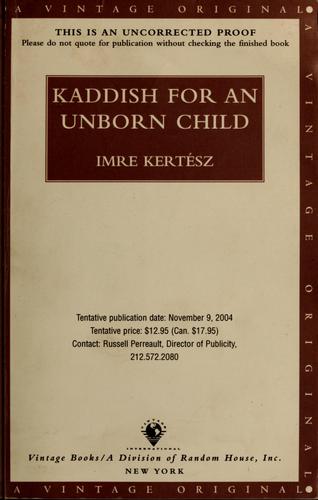
Kaddish for an Unborn Child
Imre Kertész · 1929–2016 · Hungary
Originally Kaddis a Meg Nem Született Gyermekért (Hungarian)
Why it matters
An Auschwitz survivor explains, in one relentless unbroken sentence, why he refused to bring a child into the world he knows. Kertész's fiercest and most philosophically uncompromising book.
At a glance
A single unbroken, relentless sentence-monologue with no chapter or paragraph relief.
Deep dive
A colleague's ordinary question about children gets answered with a flat 'No,' and the entire unbroken sentence that follows spends itself explaining a refusal most readers assume they already understand before they've read a page of it.
Written for readers who have finished the book. No plot recap, and nothing here is safe to read first.
Themes & symbolism
Kertész opens on that single syllable, 'No!', fired back at a stranger's idle question, then structures the rest of the monologue as an explanation addressed directly to the child the narrator will never have. He borrows the form of the Kaddish, the Jewish mourner's prayer, and redirects it toward someone who was deliberately prevented from existing in the first place, collapsing the usual order of things: mourning ordinarily follows a death, here it precedes and forecloses a birth, so that refusal and grief become impossible to tell apart.
The narrator's ex-wife wanted children and eventually left him for a second marriage that gave her one; his refusal, replayed and re-argued across the monologue, is not offered as trauma he couldn't get past but as a fully reasoned position, that to have a child is to hand a new person over to a world whose basic order already produced Auschwitz, and that anyone who has genuinely understood the camps forfeits the right to keep manufacturing more people exposed to that same possibility. The manuscript he spent over a decade writing in isolation, rejected repeatedly before it found a reader, stands in as the only offspring he will permit himself, a continuation of his own life that doesn't require bringing another one into existence to suffer it.
A Prayer That Was Never Really About Mourning
The traditional Kaddish, recited by mourners, never actually mentions death; it's a prayer of praise, and Kertész's monologue keeps that same displacement, circling argument and self-justification rather than settling into lament. Reading it as elegy misses what makes it strange: it's closer to a legal brief the narrator keeps re-filing against his own past, addressed to a child who will never read it, praise and accusation braided into the same relentless sentence.
A Father Inherited Only as a Warning
The narrator's memories of his own cold, remote father recur throughout as the model he refuses to reproduce, less a wound to be healed than evidence entered into his case: fatherhood, as he experienced receiving it, is a mechanism for transmitting damage forward with no guarantee the next generation absorbs it any better than he did. Refusing to become a father himself is framed as the one place in his life where inherited damage can actually be made to stop rather than simply repeat.
The last seal: what actually happens, and why it lands the way it does.
The ending, explained
The monologue's final stretch turns from argument toward something closer to tenderness, addressing the unborn child directly one last time and admitting that saying no never spared the narrator from loving what he refused to create, only from bringing it into a world he'd already judged unfit to receive it. Kertész declines to let the ending resolve into either vindication or regret; the 'No' still stands exactly where it started, but the book closes having shown that the fiercest possible refusal and the deepest possible love can occupy the same unbroken sentence without canceling each other out.