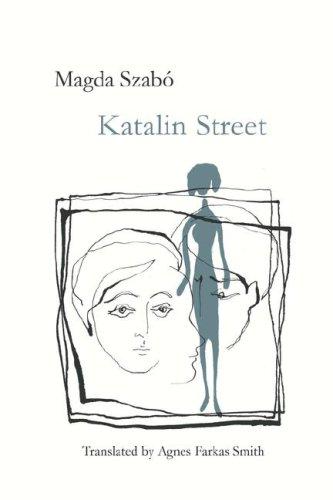
Katalin Street
Magda Szabó · 1917–2007 · Hungary
Originally Katalin utca (Hungarian)
Why it matters
Three Budapest families, bound since childhood, are scattered by the war and reunited decades later, still haunted by a daughter lost in 1944. Szabó's quietly devastating novel of memory and irreparable loss.
At a glance
Shifting timelines and perspectives across decades, though prose remains clear.
Deep dive
Three Budapest families raise their children together on one street until the war scatters them, and decades of shared Communist-era housing can't undo what none of them will say out loud about the friend they lost.
Written for readers who have finished the book. No plot recap, and nothing here is safe to read first.
Themes & symbolism
Irén, Blanka, Bálint, and Henriette Held grow up running between three adjoining houses on Katalin Street with the kind of unexamined, total intimacy childhood makes possible, until the German occupation and the deportation of Budapest's Jews reaches the Held family and Henriette, hidden with a neighboring family for her own safety, dies after leaving that shelter, a wartime loss Szabó withholds and circles rather than narrating directly, the same way the surviving characters spend the rest of the book failing to look straight at it. Szabó rotates the narration among the surviving Elekes and Bíró children across four decades, and each version of the street's history carries a slightly different, self-protective account of what any of them could have done differently.
The postwar Communist state's requisition of private housing, which crams displaced families into shared, subdivided apartments, becomes Szabó's bitter counter-image to the street's prewar idyll: physical proximity restored by force rather than affection, the families now sharing walls without ever again sharing the ease that once made three separate houses feel like one household. Henriette herself returns across the novel not as memory but as an apparition, visiting the surviving adults in scenes the narration never fully distinguishes from imagination, Szabó's way of insisting that a guilt this specific doesn't fade into abstraction with time, it simply learns to wait in the room.
A Street That No Longer Exists
Postwar redevelopment and renumbering left the real Budapest street Szabó modeled Katalin Street on unrecognizable, its houses altered or gone, so the novel's characters are left carrying a geography that the city itself has stopped preserving. Szabó makes that erasure part of the book's method: without a stable physical setting left to visit, memory has to do the work that a preserved street might otherwise have done for these families, which is part of why the narration keeps returning to the same rooms and gardens as if repetition alone could hold them in place. The novel's fractured, non-chronological structure mirrors that loss formally, refusing readers the comfort of a single, stable timeline in the same way its characters are refused a street to go back and stand on.
The last seal: what actually happens, and why it lands the way it does.
The ending, explained
Bálint, now an old man, finally admits what none of the survivors have said aloud in decades, that he might have kept Henriette from leaving her hiding place that day, a single possible intervention that has shadowed every one of his subsequent choices, including his eventual, loveless marriage to Irén's sister rather than to Irén herself. Irén, confronting the same unspoken history from her own side, recognizes that the street's supposed idyll was already fracturing along national and religious lines well before the war made the fracture lethal. Szabó ends without absolution: Henriette's apparition simply continues appearing to the people who failed her, a haunting the novel refuses to resolve into either forgiveness or punishment, only permanence.